Jersey Intel Exclusive
DoD preps N.J. bases for 90-day grid collapse; public gets 3 days
As the Pentagon's new FORTRESS initiative orders U.S. military bases to survive 90 days completely cut off from civilian electricity, water, and supply chains, federal procurement records show power and microgrid gaps at Joint Base McGuire-Dix-Lakehurst, Picatinny Arsenal, and Naval Weapons Station Earle in New Jersey — while civilian families are still told to keep just 3 days of supplies.
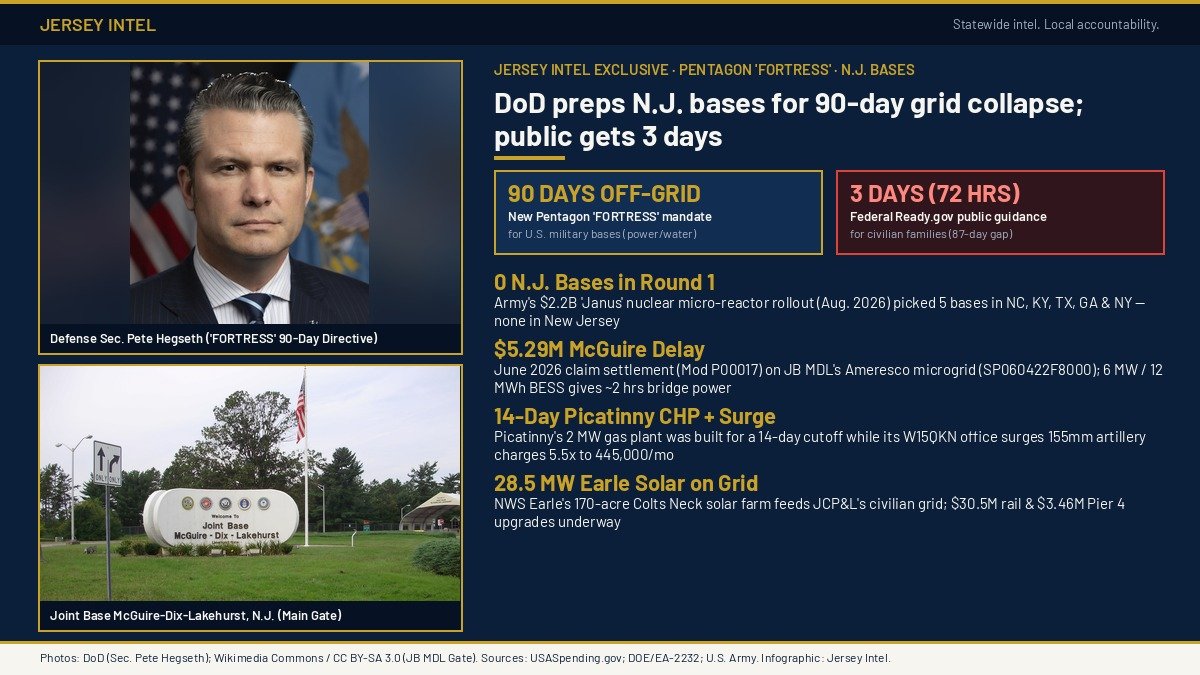
JERSEY INTEL EXCLUSIVE
First reported by Jersey Intel. TRENTON, N.J. — The Pentagon is preparing every major U.S. military installation to operate for at least 90 days completely cut off from civilian electricity, municipal water systems, fuel pipelines, and commercial supply chains under a sweeping wartime initiative called FORTRESS, first detailed by Fox News Digital on Sunday, Oct. 25, 2026. Yet an audit of federal procurement and environmental filings by Jersey Intel shows that New Jersey’s three strategic military hubs — Joint Base McGuire-Dix-Lakehurst, Picatinny Arsenal in Rockaway Township, N.J., and Naval Weapons Station Earle in Colts Neck, N.J. — were left out of the Army’s first $2.2 billion nuclear micro-reactor rollout, face construction delays on base microgrids, and remain tied to civilian utilities while regular New Jersey families are still told by federal and state agencies to keep just three days (72 hours) of emergency supplies.
That 87-day gap between how the Department of Defense is hardening military bases inside the continental United States and what civilian agencies tell the public raises an urgent question for New Jersey’s 9.3 million residents: Why is the Pentagon preparing for a three-month domestic infrastructure collapse right now — and why isn’t anyone telling the general public how to prepare for more than a long weekend?
Image: Jersey Intel infographic. Photos: U.S. Department of Defense (Defense Secretary Pete Hegseth); Wikimedia Commons / CC BY-SA 3.0 (Joint Base McGuire-Dix-Lakehurst Main Gate).
- What the Pentagon is preparing for: Under Defense Secretary Pete Hegseth’s FORTRESS initiative (Federal Operations for Resilience, Troop Resources, Energy, Supply, and Survivability), U.S. military bases must be able to disconnect (“island”) from the civilian electrical grid and municipal water systems for at least 90 days using portable nuclear micro-reactors, utility-scale batteries, and on-site generation, while pre-qualifying civilian factories to shift to wartime weapons production.
- What New Jersey contract records show: None of New Jersey’s bases made the U.S. Army’s first $2.2 billion Janus nuclear micro-reactor list announced Aug. 26, 2026. At Joint Base McGuire-Dix-Lakehurst, federal contract records (SP060422F8000) show a $5,286,591 claim settlement in June 2026 for government-caused construction delays on its Ameresco microgrid, whose 6 MW / 12 MWh battery system provides roughly two hours of bridge power. At Picatinny Arsenal, a 2-MW natural-gas cogeneration plant was built for the Army’s old 14-day standard even as Picatinny’s contracting command surges 155mm artillery propellant and shells.
- The 87-day civilian gap: While the Pentagon plans for a 90-day grid and supply-chain cutoff on American soil, FEMA’s Ready.gov and the New Jersey Office of Emergency Management still advise households to stock just 72 hours (3 days) of food and water.
1. What the Pentagon is getting ready for: Inside ‘FORTRESS’
Unveiled by Defense Secretary Pete Hegseth in his Sept. 30, 2026 “State of the Force” address and detailed in internal Pentagon documents reviewed by Fox News Digital and Air & Space Forces Magazine, FORTRESS ditches the post-Cold War assumption that the Atlantic and Pacific oceans shield the American homeland during a major war.
“We don’t want to rely on standard civilian municipal infrastructure to run our national defense. We just simply can’t. It’s an intolerable risk,” Pentagon Chief Spokesperson Sean Parnell told Fox News Digital. “Power is combat now. Without electricity, you lose communications, water, logistics, assembly lines and just basic military command structures.”
The directive establishes five core wartime requirements across roughly 500 U.S. military installations:
- 90-day off-grid base survival: Every major military installation in the continental United States must be capable of sustaining mission-critical operations independently for at least 90 days — covering electricity, water, fuel, and communications — if the surrounding civilian power grid or municipal water utility collapses.
- Portable nuclear micro-reactors, utility-scale batteries, and islanded microgrids: Rather than relying solely on diesel backup generators that run out of fuel within days, bases are ordered to deploy islandable microgrids backed by battery energy storage systems (BESS), on-site solar/geothermal/gas generation, and commercial nuclear micro-reactors under the Army and Defense Innovation Unit’s $2.2 billion Janus Program.
- Wartime stockpiles and mandatory dual supply lines: The Pentagon is setting reserve targets for munitions, fuel, critical minerals, electronics, spare parts, and medical supplies based on wartime burn rates, while requiring at least two qualified domestic production pathways for every critical defense component so the loss of a single factory cannot halt operations.
- Mobilizing civilian factories (‘Civil Reserve Manufacturing Network’): Modeled on the Civil Reserve Air Fleet, the Pentagon is pre-identifying commercial U.S. factories and locking in technical specifications, cybersecurity protections, and conversion contracts now so civilian assembly lines can pivot to wartime weapons production on short notice.
- GPS-denied and space-disrupted warfare: Hardening military command, navigation, and spectrum networks to continue operating if adversaries jam GPS or knock out U.S. satellites in orbit.
2. Why is the Pentagon preparing for this now — and why isn’t anyone telling the general public?
Parnell stated plainly why the Pentagon is racing to sever military bases from civilian utilities: “The next conflict will likely be fought on multiple fronts. Look at the geopolitics behind any major war. When that happens, global supply chains will break.”
Former Air Force Assistant Secretary for Energy, Installations, and the Environment Ravi Chaudhary was even more specific in comments to Air & Space Forces Magazine on Oct. 20, 2026: “The attack, as we know it, will not look like an attack. It will look like a systematic shutdown of community capabilities. Our adversaries are going to start with making it hard to get on base, and they’ll go for the softest targets they can, which won’t be military. It will be public works.”
That admission explains the stark contrast between the Pentagon’s 90-day internal mandate and the 3-day (72-hour) household checklist still published on FEMA’s Ready.gov:
- Day-one cyber and kinetic strikes will target civilian utilities first: U.S. intelligence agencies have repeatedly warned that state-backed cyber groups such as Volt Typhoon have pre-positioned malware inside civilian electrical substations, water treatment plants, and port cranes. In a multi-front war involving China, Russia, Iran, or North Korea, defense planners expect adversaries to attack regional grids like PJM Interconnection — which powers PSE&G, JCP&L, Atlantic City Electric, and Rockland Electric across New Jersey — to delay troop deployments from Joint Base McGuire-Dix-Lakehurst, halt naval rearming at Naval Weapons Station Earle, and disrupt munitions engineering at Picatinny Arsenal.
- Military microgrids are designed to ‘island’ bases away from surrounding towns: When an installation microgrid enters “island mode,” automated breakers physically disconnect the base from the local utility feeder. Even if a base generates its own nuclear or solar power inside the perimeter fence, the civilian towns right outside the gate — such as Wrightstown and Pemberton near McGuire-Dix-Lakehurst, Rockaway Township and Wharton near Picatinny, or Colts Neck and Middletown near Earle — remain on the civilian grid.
- Why officials don’t announce a 90-day civilian stockpile rule: Most municipal water utilities, cell towers, and community hospitals carry only 24 to 72 hours of on-site diesel generator fuel, and urban/suburban supermarkets hold roughly three days of inventory on shelves. If federal or state officials publicly instructed 9.3 million New Jersey residents to stockpile 90 days of non-perishable food, bottled water, prescription drugs, propane, and physical cash all at once, it would trigger immediate retail shortages, fuel runs, and banking liquidity shocks.
3. What federal contract records show at New Jersey’s 3 major military bases
To test how prepared New Jersey’s defense installations actually are for a 90-day off-grid mandate, Jersey Intel audited active Department of Defense, Defense Logistics Agency (DLA Energy), Army, Air Force, and Navy contracts on USASpending.gov, Department of Energy NEPA filings (DOE/EA-2232), and SAM.gov industrial-base solicitations.
First, when the U.S. Army and the Defense Innovation Unit announced up to $2.2 billion on Aug. 26, 2026 under the Janus Program (implementing Executive Order 14299 to operate a first military nuclear micro-reactor by September 2028), the five initial installations selected were Fort Bragg (N.C.), Fort Campbell (Ky.), Fort Hood (Texas), Fort Benning (Ga.), and Fort Drum (N.Y.). Zero New Jersey military bases were included in the initial nuclear micro-reactor round.
| N.J. Installation | Key Power / Resilience Contract & Vendor | Obligated / Value | Current On-Site Capacity vs. 90-Day ‘FORTRESS’ Mandate |
|---|---|---|---|
| Joint Base McGuire-Dix-Lakehurst (Burlington / Ocean / Monmouth) |
SP060422F8000 (Ameresco, Inc. ESPC) + FA448410F0001 | $27.77M obligated on Phase II/III ($140M–$250M buildout; $574M max ceiling) + $100.77M Phase I | ~31.5 MW solar, 6 MW / 12 MWh BESS (~2 hrs bridge power), and 4 MW natural-gas generators (DOE/EA-2232). Hit with a $5.29M federal delay claim settlement in June 2026 (Mod P00017) and a $153,503 Year 1 savings shortfall (Mod P00011). |
| Picatinny Arsenal (Rockaway Twp., Morris County) |
DAAE30-97-D-1002 (0004) & W15QKN25FA331 (Energy Systems Group, LLC) | $160.14M combined ($149.95M Order 0004 + $10.19M Nov. 2025 continuation through Sept. 2028) | Operates an $8.4M, 2-MW natural-gas cogeneration (CHP) plant supplying electricity and steam, engineered under the Army’s old 14-day resilience standard and dependent on New Jersey Natural Gas pipelines (with optional propane backup). |
| Naval Weapons Station Earle (Colts Neck / Leonardo, Monmouth County) |
N4008526C0008 (Union Paving) & N4008525F4984 (MN-BMCD ML JV) | $30.53M ammo rail corridor repairs/design + $3.46M Ammo Pier 4 electrical upgrade + $9.86M wastewater plant | Hosts the 170-acre, 28.5-MW Ben Moreell Solar Farm, which feeds directly into JCP&L’s commercial grid and would require additional microgrid investment and battery storage to island the base for 90 days. |
| 177th Fighter Wing / Atlantic City Airport Defense Complex (Egg Harbor Twp., Atlantic County) |
692M1525C00003 (Scalfo Electric) & W912BU25C0032 (Togiak Logistics) | $26.08M 69kV self-healing ring-bus substation + $2.47M USACE backup power + $6.85M entry control facility | Upgrading main substation with automated fault detection and self-restoration through Nov. 2028, but still dependent on regional Atlantic City Electric transmission lines. |
Joint Base McGuire-Dix-Lakehurst: $5.29M delay settlement and 2-hour battery bridge
Spanning 42,000 acres across Burlington, Ocean, and Monmouth counties, Joint Base McGuire-Dix-Lakehurst (JB MDL) is the Defense Department’s only tri-service joint base and the East Coast’s primary air mobility and refueling hub. Under Energy Savings Performance Contract SP060422F8000 (awarded Oct. 18, 2021 through March 1, 2046 to Ameresco, Inc.), the base has been deploying ~31.5 MW of solar arrays, 90,000+ LED fixtures, and an islandable microgrid control system.
However, federal contract records and the Department of Energy’s Final Environmental Assessment (DOE/EA-2232) show significant hurdles between JB MDL’s current system and a 90-day total cutoff:
- $5,286,591 delay settlement in June 2026: On April 9, 2026 (Mod P00015) and June 24, 2026 (Mod P00017), the Defense Logistics Agency obligated $5,286,591 under CLIN 004AE to pay Ameresco’s certified claim for government-caused construction delays on the JB MDL microgrid contract. Earlier, on Dec. 4, 2025 (Mod P00011), the government recorded a $153,503 Year 1 energy-savings shortfall.
- 2-hour battery bridge and natural-gas pipeline reliance: According to DOE/EA-2232, JB MDL’s battery energy storage systems — a 4 MW / 8 MWh battery at McGuire and a 2 MW / 4 MWh battery at Lakehurst (6 MW / 12 MWh total) — are sized to supply 4 MW of critical load for up to two hours while two 2-MW natural-gas generators at McGuire and a 2-MW standby generator at Lakehurst spin up. If civilian natural-gas pipelines are depressurized during a winter grid attack, solar and a two-hour battery buffer cannot carry 24/7 flightline and command loads for 90 days.
- Ongoing water and grid spending: Separate Air Force task orders show over $33.8 million obligated to PRIDE Industries across FY2024–FY2026 (including $6.15 million under FA448426F0099 in March 2026) to operate and maintain base water supply and distribution systems, plus $4.38 million to Direct Energy Business LLC (FA448424F0175) for commercial grid electricity.
Picatinny Arsenal: A 14-day power plant at the nerve center of the Pentagon’s munitions surge
In Morris County, Picatinny Arsenal in Rockaway Township, N.J. is the U.S. Army’s Joint Center of Excellence for Guns and Ammunition — employing more than 6,000 engineers, scientists, and contracting officers who design nearly 90% of the Army’s lethality and manage the nation’s ammunition industrial base through U.S. Army Contracting Command–New Jersey (W15QKN).
Federal records show Picatinny sits at the exact intersection of two FORTRESS pillars:
- Built for a 14-day cutoff, not 90 days: Under long-running Energy Savings Performance Contracts with Energy Systems Group, LLC ($149.95 million under DAAE30-97-D-1002 Order 0004 plus a $10.19 million continuation contract W15QKN25FA331 awarded Nov. 1, 2025 through Sept. 30, 2028), Picatinny operates an $8.4 million, 2-megawatt natural-gas cogeneration (CHP) plant that provides electricity and year-round steam for munitions laboratories. When the plant was commissioned, Army leadership noted it was built to meet the Army’s old requirement to sustain critical missions for a minimum of 14 days — less than one-sixth of the new 90-day FORTRESS threshold.
- Spearheading the wartime munitions surge and factory mobilization: At the same time, Picatinny’s W15QKN contracting office is executing the exact industrial-base surge and “dual supply pathway” mandate described in FORTRESS:
- Awarding a $961+ million 155mm artillery expansion package, a $700.06 million contract (W15QKN24F0527) to General Dynamics Ordnance and Tactical Systems for 155mm M795 projectile bodies, and a $628.48 million delivery order (W15QKN23F0644) to expand M31 triple-base artillery propellant capacity.
- Issuing SAM.gov solicitation W15QKN-25-R-1546 under Picatinny’s Life Cycle Pilot Process (LCPP), whose #1 thrust area is titled “Single Point Failure — Mitigate single or no-source of supply end-item or end-item components” across commercial and government ammunition plants.
- Issuing market surveys (W15QKN-25-X-117Y and W15QKN-25-X-128A) to qualify domestic commercial manufacturers capable of producing 80,000 Modular Artillery Charge System (MACS) units per month with wartime surge capacity of 445,000 units per month (a 5.5x surge), and 350,000 pounds per month of M31 propellant surging to 2,226,000 pounds per month.
Naval Weapons Station Earle: $30.5M ammunition rail rebuild and a 28.5-MW solar farm wired to JCP&L
In Monmouth County, Naval Weapons Station Earle spans Colts Neck, N.J. and the Leonardo waterfront on Sandy Hook Bay, connected by the Navy’s secure 15-mile Normandy Road rail and highway corridor. It is the East Coast’s premier ammunition transshipment port for U.S. Navy carrier strike groups and amphibious warships.
Federal contract awards show the Navy is pouring tens of millions into hardening Earle’s ammunition rail line and waterfront piers, but its largest on-site renewable power plant is not yet configured as a 90-day islanded microgrid:
- $30.53 million to rebuild the Normandy Road ammunition rail corridor: On April 15, 2026, Naval Facilities Engineering Systems Command (NAVFAC) Mid-Atlantic awarded $17,154,700 (N4008526C0008) to Union Paving & Construction Co. to repair 16 degraded corrugated metal pipe culverts supporting the Normandy Road ammunition rail crossing over the Swimming River, following a $13,371,583 contract (N4008524F5413) to Jacobs Government Services Company for full architectural and engineering design to replace obsolete ammunition rail trackage at Colts Neck.
- $3.46 million Ammo Pier 4 electrical upgrade & $9.86 million wastewater overhaul: NAVFAC awarded $3,460,664 (N4008525F4984) to MN-BMCD ML Joint Venture for electrical upgrades on Ammunition Pier 4 (through August 2026), $2.75 million (N4008523C0032) to Spark Electric LLC for Pier 3 voltage regulators, and $9,858,893 (N4008521F6370) to Tantara Associates Corp. to replace the S91 Wastewater Treatment Plant.
- 28.5-MW solar farm tied to the civilian grid: While NWS Earle hosts the 170-acre, 28.5-megawatt Ben Moreell Solar Farm built by CS Energy on leased Navy land in Tinton Falls/Colts Neck, the array was built to feed directly into the commercial JCP&L grid (with a smaller behind-the-meter phase), meaning substantial utility-scale battery storage and islanding switchgear would be required to run the base off-grid for 90 days.
4. In a hypothetical grid-down scenario, how are you preparing?
If the Department of Defense now treats a multi-week or 90-day disruption to civilian electricity, water utilities, and supply chains as a realistic homeland threat, a standard 72-hour flashlight-and-water-bottle kit leaves civilian households exposed after Day 3.
Practical Household Resilience Beyond FEMA’s 72-Hour Standard
- Water autonomy (14–30+ days): Municipal water pressure relies on electric booster pumps and treatment plants with limited diesel reserves. Beyond storing 1 gallon per person per day in stackable BPA-free containers (and filling bathtub bladders at the first sign of a grid emergency), keep a high-capacity gravity water filter (such as NSF-certified ceramic/carbon filters) and unscented liquid household bleach or water-purification tablets.
- Layered backup power & safe indoor heat: Gas generators require fuel that cannot be pumped at local gas stations when the grid is down unless stations have backup power. A portable LiFePO4 (lithium iron phosphate) solar power station paired with foldable 200W–400W solar panels can indefinitely recharge phones, radios, medical devices (such as CPAP machines), and LED lanterns, while indoor-safe propane heaters (with battery-powered carbon monoxide detectors) or wood/pellet stoves prevent frozen pipes in winter.
- Rotating 30-to-90-day pantry & critical prescriptions: Instead of buying expensive freeze-dried rations all at once, build a “deep pantry” of shelf-stable foods your family already eats (rice, pasta, oats, canned proteins, beans, cooking oil, salt, coffee, and infant/pet supplies) plus a manual can opener and camp stove. Ask your physician or insurer about a 90-day mail-order supply for essential daily medications.
- Offline cash, paper records, and the half-tank rule: During prolonged power or cyber outages, ATMs, credit-card terminals, and digital wallets stop working. Keep a reserve of small bills ($1s, $5s, $10s, $20s) in a waterproof fire safe alongside printed copies of deeds, insurance policies, IDs, and emergency phone numbers, and never let your vehicle’s fuel tank drop below half full.
- Grid-independent communications: When cell towers exhaust their backup batteries after 8 to 24 hours, a hand-crank/solar NOAA weather and AM/FM shortwave radio and short-range FRS/GMRS two-way radios for family members provide vital local updates without cellular service.
For New Jersey homeowners evaluating permanent home-resilience upgrades — such as whole-home backup generators, rooftop solar with battery storage, or electrical panel upgrades — you can calculate the cost and resale value impact of home improvements using the free NJ Home Renovation ROI Calculator on GardenState.ai, or check your property’s current market valuation and local comparables with the Free NJ Home Value & CMA Tool.
Tip: Work at or contract with a New Jersey military installation or utility provider? Send tips and public procurement records to jerseyintel@gmail.com.
Jersey Intel asks: Why do you think the Pentagon is preparing U.S. bases for a 90-day domestic grid and supply-chain collapse while the public is still told to keep just 3 days of supplies — and in a hypothetical grid-down scenario, how are you and your family preparing? Share your take in the comments.