Article
Lakewood power plants named in six federal emergency orders this year that let units exceed pollution limits
JERSEY INTEL EXCLUSIVE
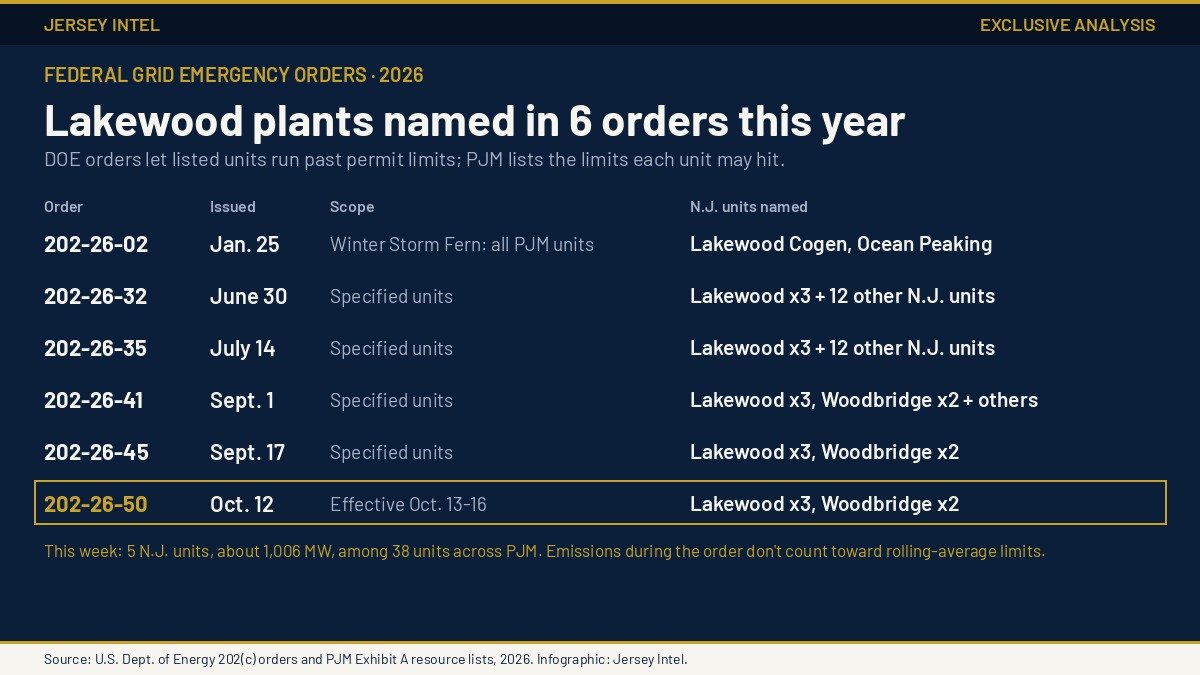
Three gas-fired units in Lakewood and two in Woodbridge are on the list of power plants that a federal emergency order lets run past their air-pollution permit limits this week. A Jersey Intel review of every 2026 order shows it is the sixth time this year the Lakewood units have been named.
Infographic: Jersey Intel. Source: U.S. Department of Energy 202(c) orders and PJM Exhibit A resource lists, 2026.
- What we know: DOE Order No. 202-26-50, in effect Oct. 13 through Oct. 16, names five New Jersey generating units, about 1,006 megawatts, among 38 units across the 13-state PJM grid.
- Why it matters: The order says emissions, run hours and fuel burned under it “will not be counted toward applicable rolling-average based limitations.” For the Lakewood units, the limits listed are nitrogen oxides, carbon monoxide, particulate matter, volatile organic compounds and opacity, plus ammonia at one unit.
- What’s next: PJM must report daily to DOE which units actually ran under the order. Those reports have not been posted.
The U.S. Department of Energy issued the order on Oct. 12 under Section 202(c) of the Federal Power Act, after PJM Interconnection, the grid operator for New Jersey and 12 other states plus Washington, D.C., asked for it on Oct. 11. PJM forecast demand of about 111,500 megawatts on Oct. 13 and said it expected to be within 900 megawatts of its reserve margin on Oct. 14, with 61,591 megawatts of generation out of service, much of it for planned fall maintenance.
The order lets PJM dispatch the listed units “in excess of Operating Limits” when it decides that is needed to keep the lights on. PJM told DOE the order may lead to exceedances of permit limits on sulfur dioxide, nitrogen oxides, carbon monoxide, wastewater releases and other pollutants, including ammonia.
The New Jersey units
PJM’s list, called Exhibit A, names these New Jersey units and the limits each may run into:
- JC Lakewood NUG F, Lakewood (dual-fuel natural gas and fuel oil), 208 MW: nitrogen oxides, carbon monoxide, ammonia, particulate matter, volatile organic compounds and opacity.
- JC Lakewood 1 CT and JC Lakewood 2 CT, Lakewood (natural gas), 194 MW each: nitrogen oxides, carbon monoxide, particulate matter, volatile organic compounds and opacity.
- JC Woodbridge 1 CC and JC Woodbridge 2 CC, Woodbridge (natural gas), 205 MW each: nitrogen oxides and carbon dioxide, measured as three-hour block averages.
PJM’s January list for the Winter Storm Fern order identified the Lakewood plants by name: Lakewood Cogen and Ocean Peaking Power, both listed under Cogentrix. The current list uses only PJM unit codes. The other 33 units are in Pennsylvania, Illinois, Maryland, North Carolina and West Virginia.
Six orders since January
DOE has issued 13 Section 202(c) orders to PJM in 2026, plus five extensions, according to its own list of orders. Some keep specific plants, such as Eddystone in Pennsylvania and Wagner in Maryland, from retiring. Others authorize backup generators at data centers and other large customers.
Six of the orders let PJM run units past their limits, and Jersey Intel checked each one’s resource list. The Lakewood units appear in all six: the Winter Storm Fern order in January (202-26-02) and the June 30, July 14, Sept. 1, Sept. 17 and Oct. 12 orders (202-26-32, as extended, and -35, -41, -45 and -50). The Woodbridge units appear in the last three.
The summer lists named more of the state. The July 14 list included 12 other New Jersey entries besides Lakewood. Among them were the Linden 5 through 8 and Bergen 2 units, Kearny, the Gilbert plant in Milford, and units in Millville, Vineland and Linden. It also included West Deptford’s Crown Point plant, where the limit listed was a state wastewater discharge temperature restriction.
The order also lets PJM tell backup generators at data centers and other large customer sites to run as a last resort before rolling blackouts. Hospitals, 911 centers, water plants and similar sites are excluded. PJM had asked that those generators be allowed to run “notwithstanding any applicable environmental limitations under federal, state, or local law or regulation.”
What we don’t know
The order does not say whether any New Jersey unit has actually run past its limits this week, or in the earlier orders. PJM must send DOE a daily notice naming each unit that ran under the order, but DOE has not posted those notices. The order also does not say how much extra pollution the units may emit.
Jersey Intel could not find any public statement from the New Jersey Department of Environmental Protection about this year’s orders or the New Jersey units on them. The New Jersey Board of Public Utilities is on the order’s service list.