Article
About 365 bears killed in NJ hunt’s first phase. The state’s latest published population estimate is from 2020
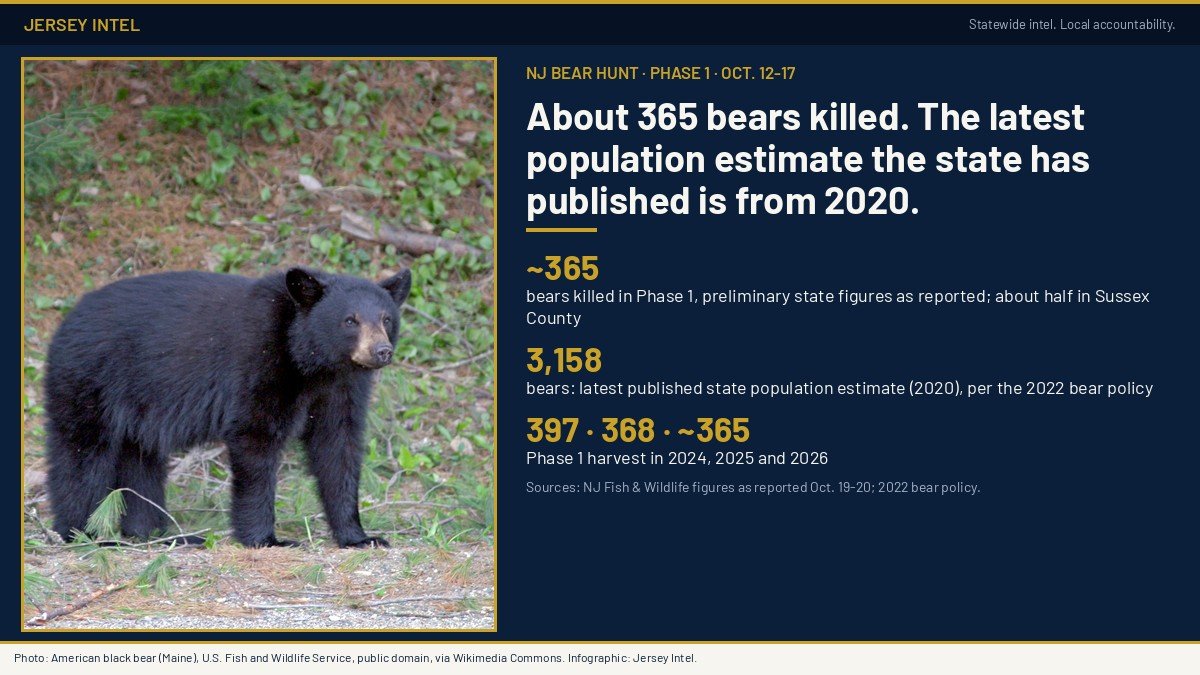
Hunters killed about 365 black bears in the first phase of New Jersey’s 2026 bear hunt, according to preliminary state figures as reported. The state is still citing a 2022 population projection, and the most recent formal population estimate it has published, 3,158 bears, is for 2020. Jersey Intel has filed a records request for any newer estimates.
Image: Jersey Intel infographic. Photo: American black bear in Maine, U.S. Fish and Wildlife Service (public domain), via Wikimedia Commons. It is not a New Jersey bear.
- What we know: About 365 bears were killed Oct. 12-17, with about half in Sussex County, per preliminary NJ Fish & Wildlife figures as reported. The October harvest has dipped each year since 2024: 397, then 368, then about 365.
- Why it matters: The state’s case for the hunt rests on a growing bear population, but the latest formal estimate it has published is for 2020. Opponents say the state’s estimates are unreliable and the population is smaller. Neither side’s claim can be checked against a current, published count.
- What’s next: Phase 2 runs Dec. 7-12. Jersey Intel has asked the Department of Environmental Protection for any population estimates since 2021, the tagged-bear count behind this year’s harvest rate, and town-level check-station records.
Hunters killed about 365 black bears during the first phase of New Jersey’s 2026 bear hunt, which ran Oct. 12 to 17, according to preliminary state Division of Fish & Wildlife figures as reported by local news outlets. Patch reported 367 bears on Tuesday, citing Fish & Wildlife. WRNJ Radio reported 362 on Monday, citing the same agency. The state posts its harvest numbers as preliminary and subject to revision.
Sussex County accounted for about half: 178 bears in Patch’s count and 176 in WRNJ’s. Warren County followed with 86 to 88, then Morris with 61, Passaic with 26 and Hunterdon with 13 to 14. No bears were reported taken in Bergen, Somerset or Mercer counties.
The state reports the harvest by county and by bear hunting zone, not by town. That means there is no public count for individual communities such as Vernon or Sparta. Jersey Intel has requested the check-station records that would show where each bear was killed.
A shrinking October harvest
This year’s first-phase total is a little below last year’s and well below 2024’s. Hunters killed 397 bears in the October segment in 2024 and 368 in 2025, according to the state’s published harvest tables.
Full-season totals were 493 in 2023, 473 in 2024 and 467 in 2025. In 2025, Sussex hunters took 185 bears in the October segment, compared with about 176 to 178 this year.
A smaller harvest does not by itself mean there are fewer bears. Hunter turnout, weather and natural food supplies all affect how many bears are taken. No state report links the drop to a population decline.
The state’s population numbers
The Department of Environmental Protection’s online bear FAQ says the population in Morris, Passaic, Sussex and Warren counties is “approximately 3,000 black bears, up from approximately 1,500 in 2018.” It also says the population “is projected to grow to more than 4,000 bears in the next two years.”
That projection dates to 2022, when the state brought back the hunt. The Fish and Game Council’s 2022 Comprehensive Black Bear Management Policy, which governs the hunt, lists an estimated 1,527 bears in 2018 and 3,158 in 2020. A 2025 state appeals court opinion notes that the policy included no estimates for 2021 or 2022. The state said that was because its estimating method relies on October hunt data, and there was no October hunt in those years.
The state calculates its estimates by tagging bears and then counting how many tagged bears hunters kill. October hunts resumed in 2023, but Jersey Intel could not find a published population estimate for any year after 2020 in the hunt policy, the DEP’s bear FAQ or the court record.
What the harvest rate does and doesn’t measure
The hunt’s December rules are tied to a “harvest rate”: the share of the bears the state tagged that year that hunters kill. That is not a share of the whole population.
If the rate is below 20% after Phase 2, which runs Dec. 7 to 12, the hunt is extended Dec. 16 to 19. If it reaches 30%, the season closes. The 2022 policy says a 20% harvest rate “is needed to affect a population reduction.”
By the state’s own figures, the season-end rate was 19.0% in 2023, 24.6% in 2024 and 19.3% in 2025. That last figure was based on 166 tagged bears available for harvest, down from 199 in 2024. Jersey Intel could not retrieve the 2026 rate or tagged-bear count from the state’s harvest data page on Tuesday.
Opponents’ ‘decline’ argument
Animal-protection groups, including the Animal Protection League of New Jersey and the Bear Group, oppose the hunt. They argue the state’s population estimates are unreliable and that the bear population is smaller than officials say.
In a court challenge to the 2022 policy, the league and other challengers argued that the state’s own tagging data from the December 2022 hunt pointed to about 1,614 bears. That figure was the challengers’ calculation, not a state estimate. The Appellate Division upheld the policy on Oct. 17, 2025.
Jersey Intel found no state report or published scientific study saying New Jersey’s bear population has fallen to alarming levels. It also found no current published state estimate showing the population is still growing.
More bear encounters reported
Fish & Wildlife figures reported by Patch show 1,196 bear encounters statewide from Jan. 1 through Sept. 21 this year. That compares with 977 in all of 2025. Morris County rose from 174 to 283 and Somerset from 26 to 67. Sussex was nearly flat, at 349 so far this year compared with 350 in all of last year.
Opponents say better garbage control, not hunting, is the way to reduce conflicts. The DEP urged residents to secure garbage and other bear attractants in an Oct. 6 release. The department also backs the hunt, calling population reduction the only scientifically sound way to restrain the population’s growth.
Politics
Jersey Intel found no public statement on this year’s hunt from Gov. Mikie Sherrill. The Animal Protection League has urged supporters to call her office.
In the Legislature, A2005, sponsored by Assemblywoman Annette Quijano, would cut the number of sportsmen on the Fish and Game Council from six to three. It would add three members recommended by animal-welfare groups. The bill has sat in the Assembly Agriculture and Natural Resources Committee since Jan. 13. A similar Senate bill, S471, was withdrawn May 21.
Questions for the state
- Has Fish & Wildlife calculated a population estimate from the 2023, 2024, 2025 or 2026 October hunts? If so, what are the numbers, and why haven’t they been published?
- How many tagged bears is the state using for the 2026 harvest rate, and what was the rate after Phase 1?
- Does the state still project more than 4,000 bears?
- Where in Sussex County were this year’s bears killed?
Jersey Intel filed an Open Public Records Act request with the DEP on Oct. 20 seeking those records. We are seeking comment from the DEP’s Fish & Wildlife division and the governor’s office and will update this story with any response.
Have information or records about the bear hunt or bear encounters in your town? Email jerseyintel@gmail.com.
By Staff