Jersey Intel Exclusive
NJ BPU cuts winter access to low-income utility aid in $4M program
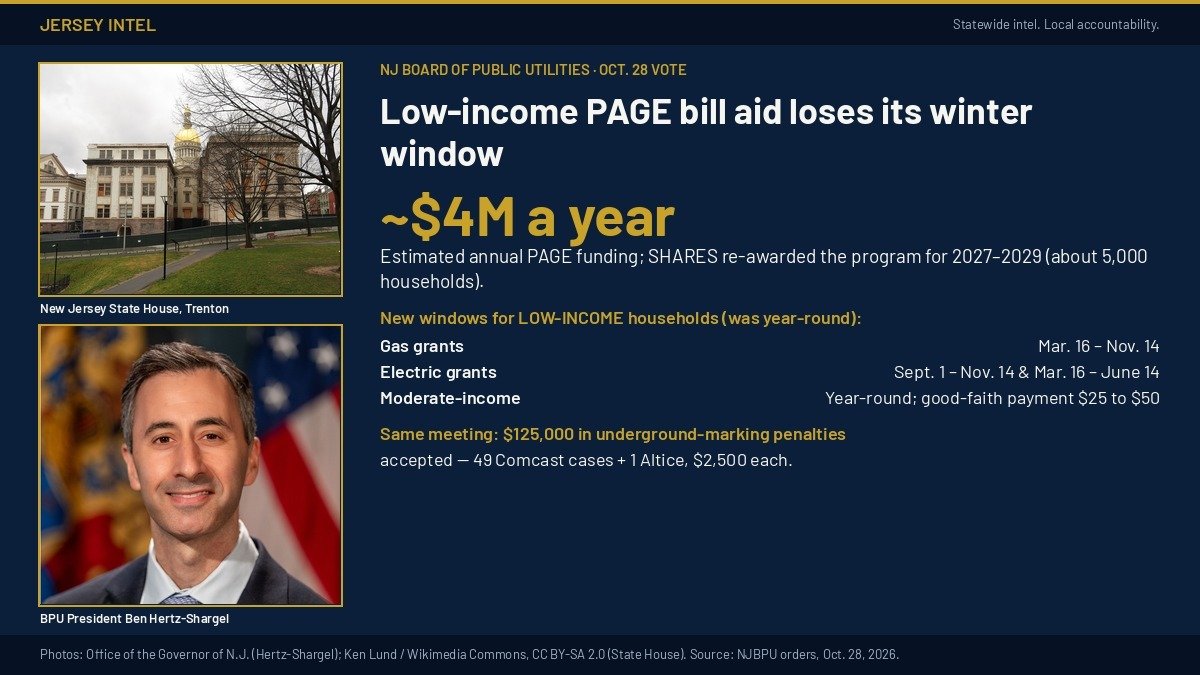
New Jersey's utility board re-awarded its roughly $4 million-a-year PAGE bill-aid program to NJ SHARES but closed the winter application window for low-income households.
JERSEY INTEL EXCLUSIVE
First reported by Jersey Intel. TRENTON, N.J. — New Jersey’s utility regulators on Wednesday handed the state’s roughly $4 million-a-year PAGE utility bill-aid program back to the nonprofit NJ SHARES for three more years, but low-income households will no longer be able to apply for it year-round, according to the board order posted after the meeting.
Under the Board of Public Utilities order, low-income households can apply for PAGE gas grants only from March 16 through Nov. 14, and for electric grants only from Sept. 1 through Nov. 14 and from March 16 through June 14. That is about 8 months a year for gas and about 5.5 months for electric. Moderate-income households keep year-round access.
Image: Jersey Intel infographic. Photos: Office of the Governor of New Jersey (Hertz-Shargel); Ken Lund / Wikimedia Commons (CC BY-SA 2.0) (State House).
- What we know: The BPU re-awarded PAGE to NJ SHARES for Jan. 2, 2027, through Dec. 31, 2029, and closed the winter window for low-income applicants.
- Why it matters: PAGE pays overdue gas and electric bills to stop or reverse shutoffs, and SHARES estimates it reaches about 5,000 households a year.
- What’s next: The order takes effect Nov. 4, and staff can adjust the low-income windows during the contract.
What changed, and why
PAGE, short for Payment Assistance for Gas and Electric, is funded by unclaimed utility deposits. The order says SHARES expects to serve about 5,000 households a year with “the average $4 million of estimated annual funding,” with grants capped at $500 per utility for low-income homes and $700 per utility for moderate-income homes.
SHARES, PAGE’s current administrator, proposed letting low-income households that already used the federal LIHEAP and state Universal Service Fund programs apply only in July, August and September, to save more money for moderate-income families. The order says about 60% of PAGE money now goes to low-income households.
Board staff rejected the three-month window as too narrow and instead limited low-income applications to the months outside the state’s winter and summer shutoff protections. The winter program protects “certain categories” of customers from disconnection from Nov. 15 through March 15. Staff can change the windows if USF, LIHEAP or PAGE funding changes.
Staff also doubled the good-faith payment moderate-income applicants must make to their utility, from $25 to $50. Two bidders competed, SHARES and Slipstream Inc. of Madison, Wisconsin, and a five-member staff committee scored SHARES highest. Utilities must hold off shutting off a PAGE recipient for at least 30 days after the grant posts.
Also approved: $125,000 in Comcast, Altice penalties
On its consent agenda, which all five commissioners approved on a roll call, the board accepted 50 settlements under the state’s Underground Facility Protection Act totaling $125,000: 49 Comcast cases and one Altice USA case, each $2,500, the law’s maximum per violation per day. Nearly all were for failing to properly mark buried cable before digging, in towns from Hillsborough to Cherry Hill. The violations date from July 2018 to August 2023, and Comcast paid on June 1, 2026, the order’s appendix shows.
Households struggling with utility costs on top of property taxes can check whether their assessment is fair with the free tools at GardenState.ai.