
Article
ACLU-NJ: Ocean County BOE’s Bay Head domicile letters are an unlawful partisan voter purge
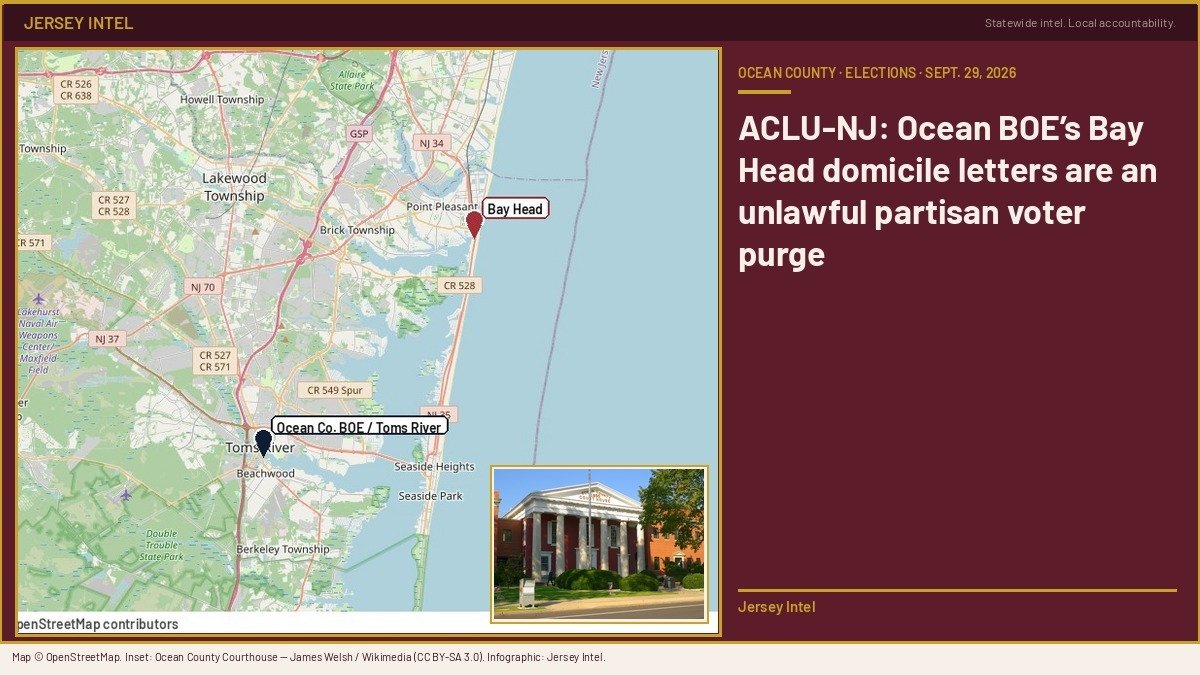
A Sept. 29, 2026 ACLU-NJ letter to Ocean County Board of Elections Chairman George R. Gilmore says a Bay Head GOP–sourced list that omitted Republicans, followed by domicile questionnaires and an Oct. 13 eligibility meeting, violates the NVRA quiet period and uniformity rules — and warns of court action if the board does not reverse course.
TOMS RIVER / BAY HEAD — The American Civil Liberties Union of New Jersey put Ocean County’s elections board on a short clock. In a five-page letter dated September 29, 2026, the group told Chairman George R. Gilmore that recent Bay Head “domicile” outreach is an “unlawful mass voter challenge” that targets voters based on political association and chills participation on the eve of a federal election.
What the letter says happened
ACLU-NJ’s account — framed as “we understand” from the facts then available — runs as follows:
- Dennis Shaning, president of the Bay Head Borough Council and of the Bay Head GOP, reviewed tax records for registered Bay Head voters whose tax bills are mailed outside the borough.
- He compiled a list that included Democrats and unaffiliated voters but omitted Republican voters, and on August 21, 2026, sent that list to the Ocean County Clerk and Board of Elections, claiming “sufficient reason” to believe the listed voters “should not be voting in Bay Head.”
- On September 15, 2026, the board (on Gilmore’s letterhead role as described by ACLU-NJ) mailed recipients a letter warning that their “right to vote may be challenged for the November 3, 2026 General Election and future elections,” enclosed a “Domicile Questionnaire” due September 30, 2026, and pointed to an October 13, 2026 board meeting where eligibility could be reviewed.
The letter argues that a tax bill’s mailing address “provides no direct evidence of domicile” under New Jersey voting residence law, and that the board’s questionnaire-plus-threat process is not part of the statutory eligibility scheme.
NVRA quiet period and uniformity
ACLU-NJ cites Section 8(c)(2)(A) of the National Voter Registration Act: systematic list-maintenance programs aimed at removing ineligible voters must be completed not later than 90 days before a federal primary or general election — the so-called quiet period. With the November 3, 2026 general election on the calendar, September mailings and an October eligibility meeting sit inside that window. The letter also invokes DOJ NVRA guidance that the quiet-period rule reaches list-maintenance programs based on third-party challenges derived from large data-matching.
Separately, the group argues the NVRA’s uniformity / nondiscrimination requirement (52 U.S.C. § 20507(b)(1)) bars a program that, on ACLU-NJ’s description, applies extra domicile scrutiny to Democratic and unaffiliated voters while leaving identically situated Republicans untouched. The letter adds First Amendment / equal-protection theories and claims under New Jersey’s John R. Lewis Voter Empowerment Act (L. 2026, c. 31) regarding intimidation and deception.
Dual hats — BOE chair and county party chair
Gilmore is addressed in his Board of Elections capacity. He also chairs the Ocean County Republican Organization, which unanimously re-elected him at its June 30, 2026 reorganization (OCRO statement, as carried by Insider NJ). That dual role is the accountability frame: the same official who chairs the elections board — which Gilmore has described to the New Jersey Monitor as bipartisan (two Republicans and two Democrats) — also leads the county party whose local club president, per ACLU-NJ, supplied a party-skewed challenge list. The ACLU letter itself does not adjudicate Gilmore’s intent; it treats the Shaning list’s omitted Republicans and the board’s follow-on letters as the operative facts.
Doubt angle — what still isn’t on the record
ACLU-NJ’s letter is a demand letter, not a court finding. Open questions that matter for accountability:
- How many Bay Head voters received the Sept. 15 letter, and what party breakdown appears on the board’s own copy of Shaning’s list?
- Did the full four-member board authorize the mailing, as Gilmore has indicated in comments to the New Jersey Monitor — and where is the resolution or minutes?
- Will the board produce the questionnaire template, returned forms, and any challenge dockets before Oct. 13?
- Separately from ACLU-NJ’s partisan-omission claim: even a perfectly bipartisan tax-bill match would still collide with the NVRA quiet-period argument if the purpose is systematic removal inside 90 days of a federal election.
Until those records are public, readers should treat the partisan-skew allegation as ACLU-NJ’s characterization of Shaning’s list, not as an independently audited finding by Jersey Intel.
Demands and deadline
ACLU-NJ asks Gilmore to: (1) cancel the Oct. 13 meeting as to the targeted voters; (2) confirm in writing by Oct. 2, 2026, 10:00 a.m. that no adverse action will follow from the Sept. 15 letters based on tax-bill mailing addresses; and (3) send corrective letters by Oct. 5, 2026. Copies went to Shaning, Senior Counsel to the Attorney General Dara Olds, and Division on Civil Rights Director Yolanda Melville.