Article
Federal grid emergency order runs through Oct. 16: what it means for New Jersey
Correction (Oct. 14, 2026): An earlier version of this story said PJM’s reports to DOE on units run under the order were not public. DOE posts PJM’s updated lists of covered units on its 2026 DOE 202(c) orders page. This story has been updated.
First reported by Hudson TV. Jersey Intel checked every figure below against the federal order and PJM’s own filings.
A federal grid emergency order now in effect through Thursday, Oct. 16, lets the regional grid operator PJM Interconnection run five New Jersey power units beyond their air-permit limits and call on the state’s electric utilities if supply runs short.
The U.S. Department of Energy issued Order No. 202-26-50 on Oct. 12 under Section 202(c) of the Federal Power Act, a day after PJM asked for it. The order is effective Oct. 13 through Oct. 16.
Why PJM asked
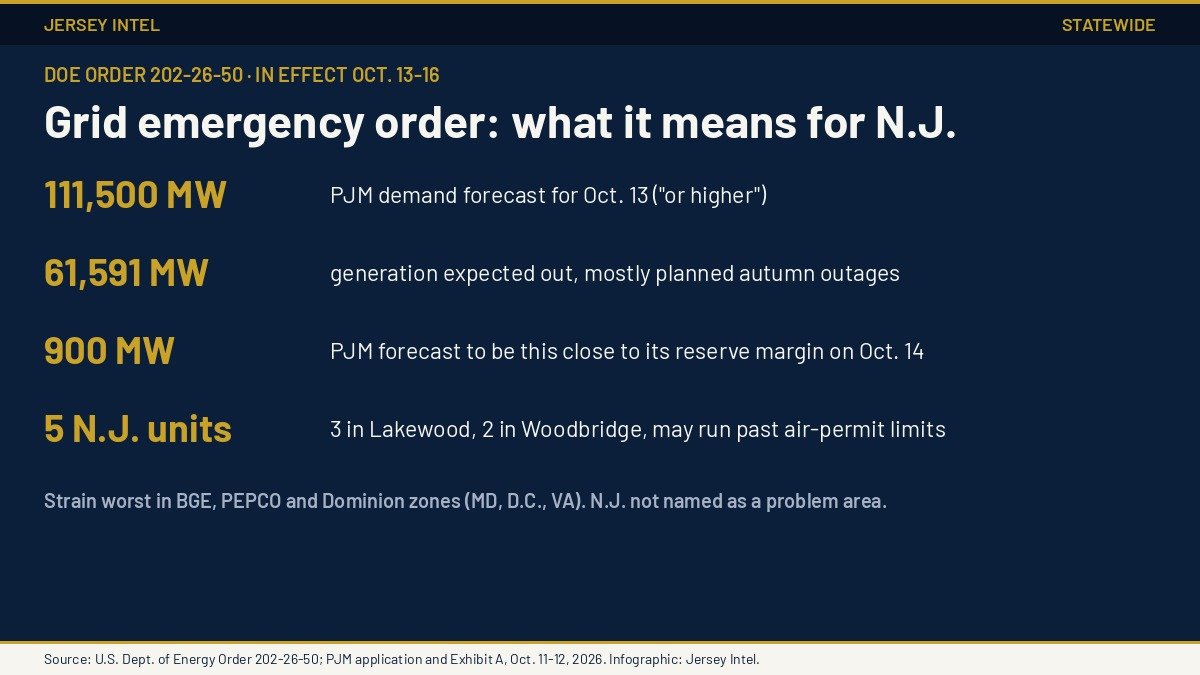
In its application, PJM said it forecast demand “at or around 111,500 MW (or higher)” on Oct. 13, while about 61,591 MW of generation was expected to be out of service, mostly for planned autumn maintenance, along with planned transmission outages. The order says PJM was forecast to be within 900 MW of its reserve margin on Oct. 14.
For comparison, PJM said peak load on Sept. 17 was 127,729 MW with only 33,899 MW of generation out. The problem this week is less about record demand than about how much of the fleet is offline for maintenance.
PJM said the problems are most acute in the BGE, PEPCO and Dominion zones, which serve Maryland, Washington, D.C., and Virginia. New Jersey is not named as a problem area.
The New Jersey units
PJM’s Exhibit A, the list of plants covered by the order, includes five New Jersey units: three in Lakewood, Ocean County, and two in Woodbridge, Middlesex County. The order lets PJM dispatch listed units “only as needed to maintain reliability,” even if that means exceeding their environmental operating limits. Jersey Intel reported Tuesday that the Lakewood units have been named in six federal emergency orders this year.
What it means for N.J. ratepayers
- Utilities on call. The order authorizes PJM to call on its transmission owners and electric distribution companies to carry it out. In New Jersey those are PSE&G, JCP&L, Atlantic City Electric and Rockland Electric.
- Backup generators as a last resort. PJM may direct customers’ backup generators, including batteries, before or during a PJM-wide or local EEA 3 event, the stage just before firm load interruption. Generators at hospitals, 911 centers, water treatment plants and similar critical sites are excluded.
- Demand response already used. PJM issued a Maximum Generation Emergency/Load Management Alert (NERC EEA 1) for Oct. 13 and Oct. 14, and dispatched pre-emergency demand response on Oct. 13 in zones including PSEG, JCP&L, ACE and RECO. It also recalled all generator maintenance outages, with a deadline of noon Oct. 14.
As of our check Wednesday morning, PJM’s emergency procedures dashboard showed no voltage-reduction or load-shed warning, and we found no public conservation call from PJM and no statement from the N.J. Board of Public Utilities or PSE&G.
What it means for air quality
Under the order, the listed units may exceed permit limits. For the Lakewood units, PJM’s list names limits on nitrogen oxides, carbon monoxide, particulates, volatile organic compounds and opacity. For Woodbridge, it lists NOx and CO2. PJM must report to DOE which units actually ran under the order. DOE posts PJM’s dated “Updated Exhibit A” filings on each order’s page on its 2026 DOE 202(c) orders page; for this order, updates are dated Oct. 12 and Oct. 13. The Oct. 13 filing lists the covered units, with each unit’s fuel, location, megawatts and restriction.
Jersey Intel has filed records requests with the N.J. Department of Environmental Protection (requests #407373 for Lakewood and #407374 for Woodbridge) seeking any exceedance reports and communications about the orders. Responses are due around Oct. 22.
UPDATE (Oct. 14, 2026): PJM spokesman Jeff Shields, senior manager of external communications, said in an email that “PJM is required to file daily reports in connection with generators that run in connection with any of these DOE 202c orders,” and that the orders and “detailed reports of which generating units ran under the order” can be found by searching for PJM on DOE’s 202(c) orders page. Shields said PJM “would not comment on specific units,” but that “generation owners notify PJM of their need to be included on the Specified Resources list in order to operate during the emergency,” with their concerns listed in each order’s Exhibit A. Jersey Intel has asked PJM whether those filings show the hours units ran beyond their limits.
What’s next
The order expires at the end of Oct. 16 unless DOE extends it, as it has done with several earlier PJM orders this year. Jersey Intel will report what NJDEP’s records show about how often the Lakewood and Woodbridge units ran past their limits.