
Article
Sherrill signs S-4515: Rutgers managerial executives can take dual pay from affiliated nonprofits — conflict-law carveout
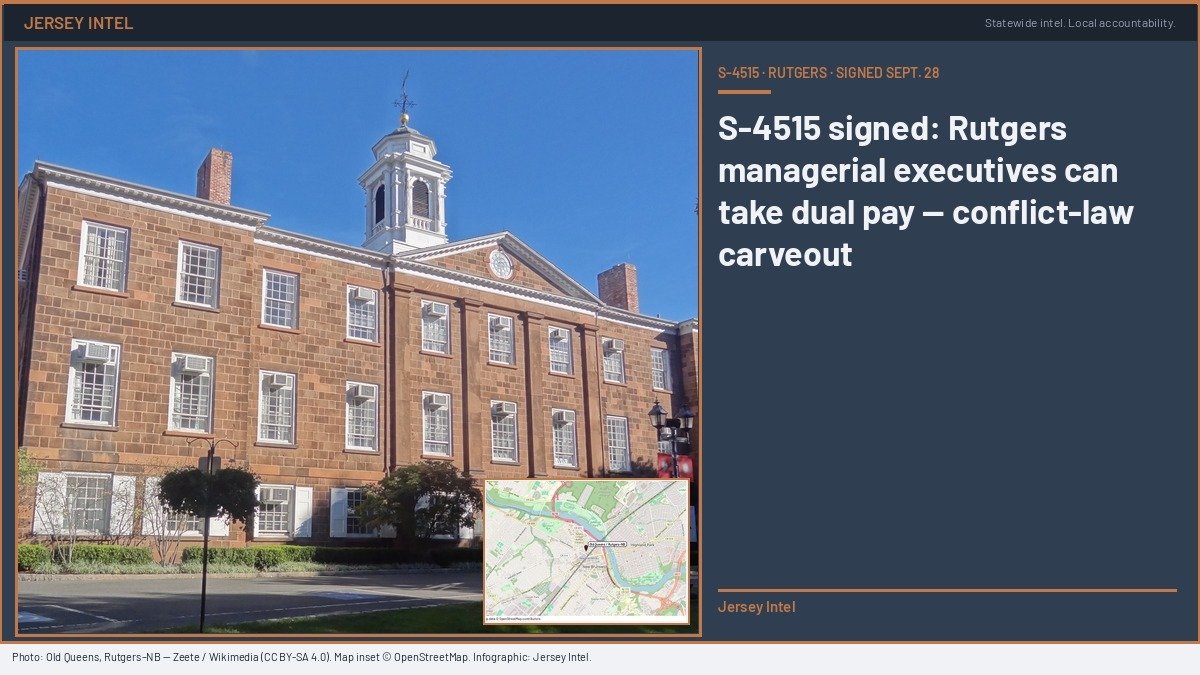
On Sept. 28, 2026, Gov. Mikie Sherrill signed S-4515/A-5350 (Mukherji/Stanley), authorizing certain Rutgers managerial executives overseeing medical education, research, or clinical care under a qualifying affiliation agreement to be employed and paid by both Rutgers and an affiliated nonprofit — explicitly exempting that dual compensation from key Conflicts of Interest Law provisions.
TRENTON / NEW BRUNSWICK — Governor Mikie Sherrill’s Sept. 28, 2026 legislation action list includes a quiet but consequential ethics rewrite for Rutgers’ academic-health leadership. Senate Bill No. 4515 (first reprint), paired as A-5350, is titled to authorize dual employment by certain Rutgers employees and affiliated contracting entities. She signed it the same day she issued absolute vetoes of S-4513 and S-4514 (municipal open-space / motor-vehicle funding bills on the Sept. 28 action list) and a conditional veto of S-4477.
What the signed bill does
As reported by the Senate Budget and Appropriations Committee on June 28, 2026, with amendments, and as reflected in the first-reprint text on njleg:
- An “affiliation agreement” means a long-term pact creating joint governance between Rutgers and a New Jersey nonprofit, aimed at an integrated academic health system for education, research, clinical care, and improved access.
- A “contracting entity” is that nonprofit (and affiliates/subsidiaries) or jointly formed entities under the agreement.
- Section 2(a): Any Rutgers employee who is a managerial executive (as defined in the Employer-Employee Relations Act, N.J.S.A. 34:13A-3) and who has oversight, supervisory, or managerial responsibility for medical education, research, or clinical care programs/divisions in connection with such an affiliation agreement may be employed by, and receive compensation from, both Rutgers and the contracting entity.
- Section 2(b): Compensation and benefits from that dual employment shall not be subject to section 13 of the Conflicts of Interest Law (C.52:13D-24) or ethics-code provisions adopted under C.52:13D-23, and the dual employment shall not be deemed a violation of paragraph (5) of subsection (e) of section 12 (C.52:13D-23) or related ethics-code rules.
- The act takes effect immediately (section 4). Labor-relations and subcontracting caveats appear in section 3 of the reprint.
The governor’s Sept. 28 release lists the bill as: S-4515/A-5350 (Mukherji/Stanley) — Authorizes dual employment by certain employees of Rutgers University and affiliated contracting entities.
What the carveout reaches — and what it does not name
The Conflicts of Interest Law provisions referenced are the familiar State-employee restrictions on outside compensation and on employment that could impair objectivity. S-4515 does not abolish those statutes statewide; it exempts this dual-pay class from them. The bill text does not name a specific hospital system. Affiliation-agreement architecture in New Jersey’s public academic-health market is widely understood to center on Rutgers’ major nonprofit clinical partners; Jersey Intel sticks to the statutory language unless and until a named agreement is produced as a primary.
Committee amendments narrowed the covered employees toward managerial executives with formal oversight roles and removed an earlier board-dual-voting section that appeared in the introduced version — readers comparing I1 vs. R1 should note that evolution.
Doubt angle — transparency after the carveout
- Who is covered in practice? “Managerial executive” plus program oversight is still a class, not a published roster. Without a disclosure schedule, the public may not see the second paycheck.
- Who benefits? Dual employers can recruit/retain executives with private-side compensation while the public university remains the statutory employer of record for some duties. Faculty unions and clinical faculty have argued, in other forums, that the structure shifts power toward affiliated systems; that advocacy is not a substitute for the bill text, but it flags the stake.
- What remains unanswered: dollar amounts, bonus structures, which contracting entities will use the carveout first, and whether Rutgers or the State Ethics Commission will publish implementing guidance.