
Article
Sherrill signs S-4420: regional rehab/reentry authority can force county ADP assessments — debt service off the levy cap
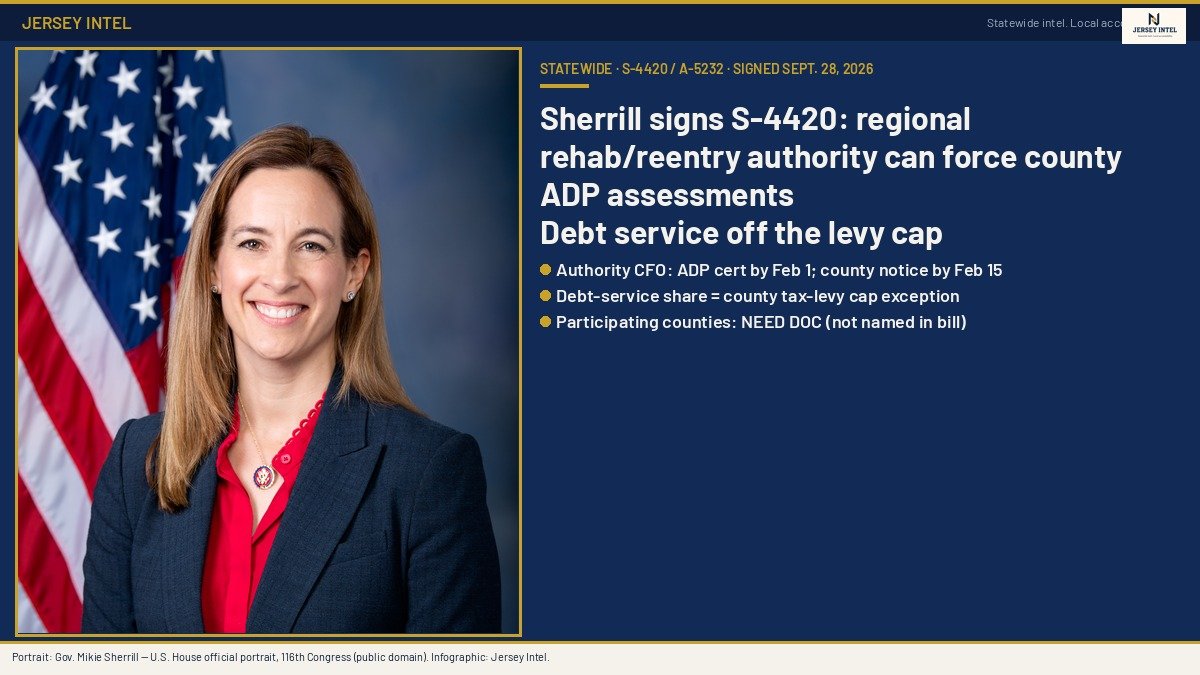
Graphic: Gov. Mikie Sherrill — U.S. House official portrait, 116th Congress (public domain) with Jersey Intel S-4420 ADP / levy-cap chalk overlay.
- What we know: Signed Sept. 28, 2026 (S-4420/A-5232, Beach/Greenwald). Authority CFO certifies prior-year ADP by Feb. 1; county CFO notice by Feb. 15. Debt-service share = levy-cap exception (new 40A:4-45.4 aa.). Effective immediately.
- Why it matters: Cap exception puts authority debt-service assessments outside the ordinary 2.5%/COLA county levy limit. DLGS checks the line before approving county budgets.
- What’s next: NEED DOC — which counties are “participating.” Bill does not name them. Watch inter-county agreement / authority minutes.
On Sept. 28, 2026, Gov. Mikie Sherrill signed S-4420/A-5232 (Beach/Greenwald), amending the regional rehabilitation and reentry center authority statute so the authority’s CFO certifies each participating county’s Average Daily Population share, notices county CFOs by Feb. 15, and treats the debt-service portion as a county tax-levy cap exception. The bill does not name which counties have joined.
TRENTON — Buried under the same Sept. 28 legislation dump as Jersey City veto headlines, Governor Mikie Sherrill signed a South Jersey–sponsored rewrite of how a regional jail-and-reentry authority bills counties.
The governor’s Sept. 28 actions release lists S-4420/A-5232 (Beach/Greenwald) among bills signed into law: “Authorizes regional rehabilitation and reentry center authority to determine county proportional share assessment for budget purposes.”
What S-4420 changes
The first-reprint Senate text amends section 6 of P.L.2023, c.346 (C.40A:67-6) — the organic powers of a regional rehabilitation and reentry center authority.
Budget / assessment mechanics (subsection o., as amended): Budget introduction and adoption run under the Local Authorities Fiscal Control Law, on a calendar fiscal year (Jan. 1–Dec. 31), and remain subject to the adjusted-tax-levy cap framework cited in the section. The prior path that conveyed an amount “to be raised by taxation” directly to county Boards of Taxation is deleted.
Instead:
- The authority’s chief financial officer certifies the Average Daily Population (ADP) of inmates from each participating county for the previous year by February 1 each year.
- Based on ADP — and, if the inter-county agreement sets a separate formula, the apportionment of any debt service — the CFO certifies each county’s proportional share of the authority’s total revenue needs, splitting what portion is general operations and what portion supports debt service.
- By February 15, each portion of that total proportional share assessment is conveyed to the respective county chief financial officer for inclusion in the county’s annual budget.
- The debt-service portion “shall be an eligible cap exception pursuant to subsection aa. of section 4 of P.L.1976, c.68 (C.40A:4-45.4)” for each participating county.
- When examining a participating county’s annual budget, the Division of Local Government Services (DCA) shall determine whether the amount of the proportional share assessment, as certified by the authority CFO, is included as an appropriation — as a condition of State approval for budget adoption under the Local Budget Law.
The new levy-cap exception
Section 2 of the bill amends the county tax-levy cap exceptions in C.40A:4-45.4 to add:
aa. Amounts certified by the chief financial officer of a regional rehabilitation and reentry center authority as the county’s share of the proportional share assessment pertaining to debt service for the authority, as specified in the amended 40A:67-6(o).
Counties still face the general rule that they may not increase the county tax levy apportioned among municipalities in excess of 2.5 percent or the cost-of-living adjustment, whichever is less — except for listed carve-outs. Debt-service assessments from this authority now sit on that exception list.
Other authority powers the section still carries
The same amended section continues to authorize the authority, among other powers, to incur indebtedness through bonds; and to “employ correctional police officers and other employees, without regard to the provisions of Title 11A, Civil Service, of the New Jersey Statutes,” without precluding collective bargaining.
S-4420’s operative rewrite for this story is the assessment / cap-exception path — not a new Civil Service debate invented here — but the Civil Service carve-out remains in the live statute text the bill amends.
Effective date
Section 3: This act shall take effect immediately.
Doubt angle — who pays, who is missing from the paper
- Who pays: Taxpayers in participating counties, through county budgets that must appropriate the certified share. The debt-service slice can rise outside the ordinary levy cap — permanent pressure if bonds are large.
- Who decides the bonds: Authority board / inter-county agreement mechanics (outside this bill’s four corners). Cap exception means other counties’ voters/commissioners do not get a levy-cap brake on that debt-service line the same way they do on uncapped operating growth.
- NEED DOC — which counties joined: The 1R text repeatedly says “participating county” / “participating counties” and references an “inter-county agreement,” but does not name Burlington, Camden, or any other county as a current member. Sponsors’ districts are Burlington/Camden — that is geography of sponsorship, not proof of membership. Jersey Intel does not invent a participant list.
- Civil Service gap: Authority may hire correctional officers outside Title 11A — accountability and labor questions for a follow once hiring begins.
- Timing: Feb. 1 ADP cert → Feb. 15 county CFO notice. A first full cycle after the Sept. 28, 2026 signature points at 2027 county budgets if those calendar deadlines are the operative clock — confirm against authority bylaws/DLGS guidance when available.
- Still unanswered in records reviewed: Executed inter-county agreement; authority board roster; any 2026 assessments already billed; bond authorization amounts.