
Article
Sherrill seats SHBP reform group — with Aetna, Horizon, and Optum Rx at the table
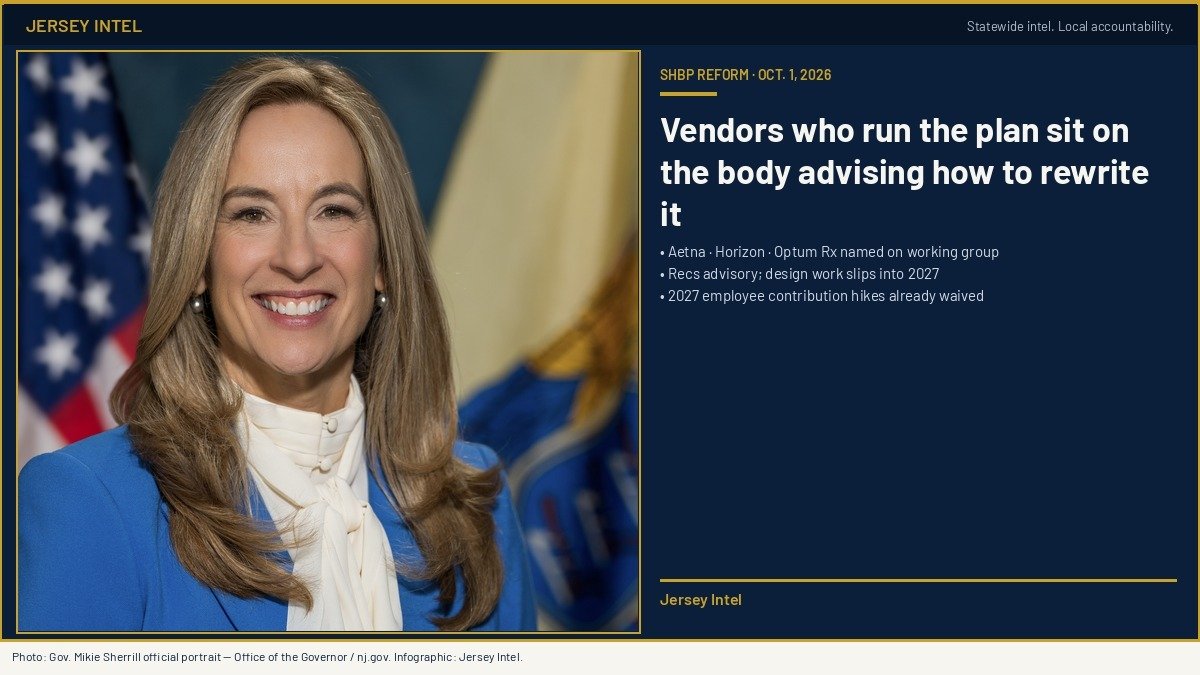
Graphic: Gov. Mikie Sherrill official portrait with Jersey Intel SHBP Reform callouts. Photo: Office of the Governor / nj.gov. Infographic: Jersey Intel.
- What we know: Oct. 1 release launches the SHBP Reform Working Group led by COO Kellie Doucette; first meeting Oct. 16. Roster expressly lists current program vendors — Aetna, Horizon Blue Cross Blue Shield of New Jersey, Optum Rx — alongside unions, hospitals, public-employer groups, and legislative offices. Recommendations are advisory to the Governor; “detailed design and implementation planning will continue in 2027.”
- Why it matters: The Sept. 2 agreement already waived increases in state employees’ health-benefit contribution rates for 2027 while promising structural reform. Taxpayers and local employers still fund the gap while vendors who administer today’s networks sit on the body shaping tomorrow’s contracting and plan design.
- What’s next: First meeting Oct. 16; watch whether conflict disclosures, recusal rules, or subcommittee charters are published; parallel Local Government Group / SEHBP work remains separate. Jersey Intel’s live Newark OSA story already flags an estimated $18.7 million in missed SEHBP savings at Newark Public Schools.
Governor Mikie Sherrill launched the State Health Benefits Program Reform Working Group on Oct. 1, fulfilling a Sept. 2 deal that waived 2027 employee contribution hikes. The roster names current program vendors among the bodies advising on vendor contracting, networks, pricing, and plan design — while detailed design work is pushed into 2027 and SEHBP/local tracks stay on a parallel track.
TRENTON — Governor Mikie Sherrill on October 1, 2026 announced the launch of the State Health Benefits Program (SHBP) Reform Working Group, saying it fulfills a commitment made last month in an agreement with 17 unions representing State employees.
The Governor’s release states the group will bring together State representatives, participating unions, and “stakeholders with relevant healthcare and program expertise” for a sustained review of SHBP’s structural challenges and “concrete, evidence-backed recommendations” on affordability and sustainability.
Chief Operating Officer Kellie Doucette will lead the working group. Its first meeting is set for October 16, with regular meetings thereafter. The same release says detailed design and implementation planning will continue in 2027, and that any resulting policy changes must still run through collective negotiations, administrative, procurement, commission, legislative, or other applicable legal processes.
What the group is charged to advise on
Per the Oct. 1 release, the working group’s advisory recommendations to the Governor will address:
- how the State administers public employee health benefits;
- how provider networks are structured and paid;
- plan pricing, premium-contribution structures, and plan and benefit design;
- how employers and members participate; and
- whether the programs have the governance, information, and operating capacity to manage costs effectively.
Dedicated subcommittees are to align with those areas.
The Sept. 2 agreement that set the Oct. 1 deadline used overlapping language: vendor contracting and program operations; claims review and eligibility verification; network innovations; plan pricing and premium-contribution structures; plan and benefit design; participation rules; and governance, data transparency, information access, and program capacity.
Who is on the roster — including current vendors
Beyond labor organizations, hospital and physician groups, public-employer associations, and the four legislative partisan offices, the Oct. 1 release lists under “Current program vendors”:
- Aetna
- Horizon Blue Cross Blue Shield of New Jersey
- Optum Rx
Those are the same categories of firms that bid for, administer, or manage medical and pharmacy networks inside the programs the working group is supposed to reform.
The Administration says it will engage additional stakeholders and experts not formally on the working group and “may add additional members.”
The Sept. 2 deal: 2027 contribution freeze already locked
On September 2, 2026, Sherrill and 17 state-employee unions announced an agreement that waives increases in state employees’ health benefit contribution rates in 2027 and commits the state to stand up a working group by October 1, 2026.
That earlier release frames New Jersey’s public employee health-benefit system as covering approximately 690,000 members across state, local government, and education plans — and describes “severe financial challenges” and structural limits on transparency, accountability, and flexibility.
Union statements in the Sept. 2 package repeatedly cast the contribution freeze as protection for members while labor gains “a seat at the table” on cost drivers. The Oct. 1 launch is the state’s public proof that the working-group half of that bargain was met on deadline.
Parallel tracks: SEHBP and local — not the same table
The Oct. 1 release is explicit that New Jersey runs several distinct health-benefit programs for State employees, local government employees, and education employees, each with different plans, participating groups, governing bodies, and legal requirements.
It says the Administration will therefore coordinate the working group’s recommendations with parallel work addressing the Local Government Group and the School Employees’ Health Benefits Program (SEHBP) — not that those programs sit on this same SHBP working-group roster as equal voting members.
That matters for readers following Jersey Intel’s Oct. 1 reporting on the Office of the State Auditor’s Newark Public Schools performance audit, which estimated the district could have saved approximately $18.7 million in fiscal years 2024–2025 by participating in SEHBP — an estimate of foregone savings, not a finding of theft. School and local cost pressure is real; it is not automatically being rewritten in the same room as the SHBP vendor-inclusive working group.
Doubt angle: who advises on the contracts they hold?
- Vendors on the reform body. The Oct. 1 roster places Aetna, Horizon, and Optum Rx inside a process whose stated scope includes vendor contracting, network structure and payment, pricing, and plan design. The release does not publish conflict-of-interest rules, recusal standards, or whether vendor members sit on the contracting subcommittee. Advisory status does not erase the optics — or the information advantage — of incumbents helping draft the playbook for the next procurement and benefit design cycle.
- Recommendations are advisory; hard design slips to 2027. The group will “develop and prioritize recommendations for the Governor,” while “detailed design and implementation planning will continue in 2027.” That is a long fuse after an agreement sold in September as urgent structural reform.
- Who covers the 2027 contribution gap? The Sept. 2 deal waived scheduled 2027 employee contribution increases. Neither release publishes a Treasury or actuary figure for how many dollars shift to the State (and ultimately taxpayers) because those hikes will not land on employees. Freeze the worker share without a published cost bridge, and the public cannot score whether reform savings, reserve draws, premium growth elsewhere, or deferred design is supposed to fill the hole.
- SEHBP / local are “parallel,” not fused. Coordinating with separate local and school tracks is not the same as putting school boards, local employers, and SEHBP’s distinct legal constraints in the same decision room. The Newark OSA SEHBP savings estimate shows how school-side dollars can diverge from state-employee SHBP politics — while still hitting the same statewide taxpayer.
- Process still has veto points. Even if recommendations are sharp, the Oct. 1 release reminds readers that implementation must clear negotiations, procurement, commissions, and/or legislation. A working group is not a rate decision.
What’s next
- October 16, 2026: first working-group meeting (per Governor’s release).
- Watch for posted agendas, subcommittee charges, conflict disclosures, and whether vendor roles are limited to data presentations vs. drafting contracting recommendations.
- Track parallel Local Government Group / SEHBP announcements separately — do not assume SHBP roster decisions automatically bind school or local plans.
- Jersey Intel will update if the state publishes membership charters, fiscal estimates for the 2027 contribution waiver, or procurement-related work products.