
Article
Ballot question for a $2,500 veterans’ tax break leaves out its $181.8 million-a-year cost to the State
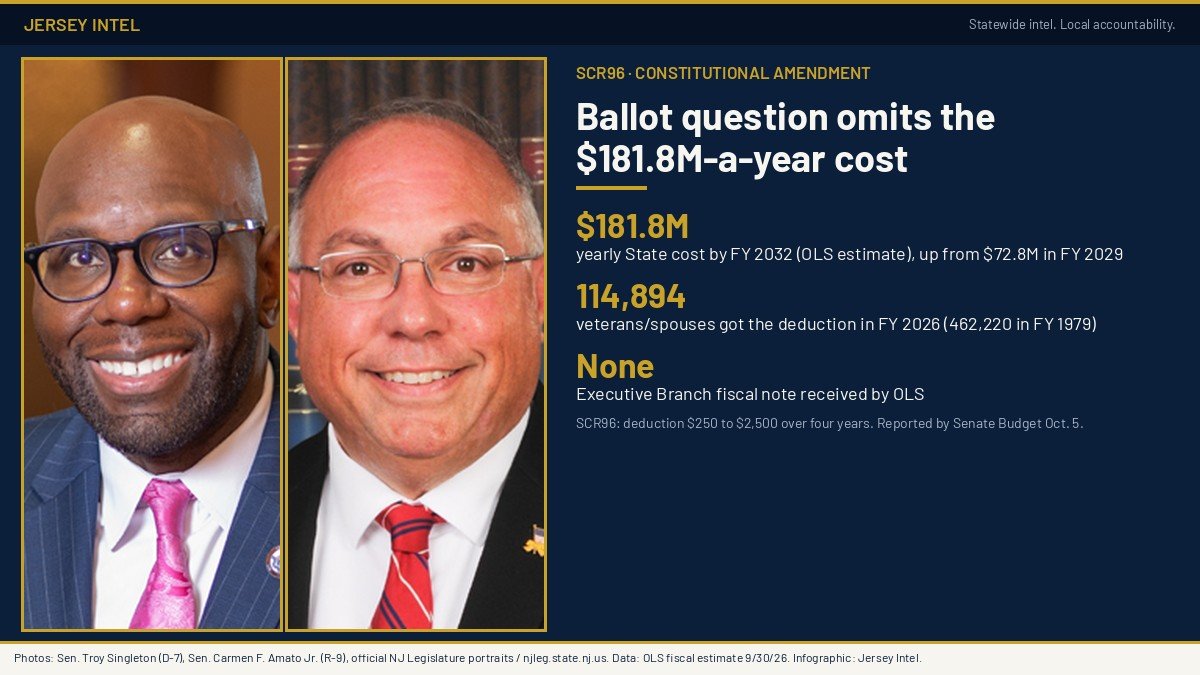
Graphic: Sen. Troy Singleton (D-7) and Sen. Carmen F. Amato Jr. (R-9), official NJ Legislature portraits / njleg.state.nj.us, with Jersey Intel callouts. Data: OLS fiscal estimate dated Sept. 30, 2026. Infographic: Jersey Intel.
- What we know: SCR96, sponsored by Sens. Troy Singleton (D-Burlington) and Carmen F. Amato Jr. (R-Ocean), was reported with amendments by Senate Budget and Appropriations on Oct. 5, 2026. As amended, the deduction would rise from $250 to $1,000 (tax year 2028), $1,500 (2029), $2,000 (2030), and $2,500 (2031 and after).
- Why it matters: The State reimburses towns for the deduction, plus 2% for administration. OLS projects State costs of $72.8M (FY 2029), $114.2M (FY 2030), $150.3M (FY 2031), and $181.8M (FY 2032), paid through the Property Tax Relief Fund. “None received,” OLS wrote about the Executive Branch’s fiscal analysis.
- What’s next: The resolution sits on the desk in both houses. It needs final legislative approval, then voters. The proposed ballot question and interpretive statement don’t mention the State’s cost.
TRENTON — A proposed constitutional amendment that would raise New Jersey’s veterans’ property tax deduction from $250 to $2,500 cleared the Senate Budget and Appropriations Committee on Monday, Oct. 5, 2026. The Legislature’s own budget analysts put the State’s cost at $181.8 million a year once the increase is fully phased in.
Senate Concurrent Resolution 96 was introduced on Feb. 9, 2026. Its primary sponsors are Sen. Troy Singleton (D-7, Burlington) and Sen. Carmen F. Amato Jr. (R-9, Ocean). Co-sponsors listed on the reprint are Sens. Corrado, Space, McKnight, Singer, A.M. Bucco, Steinhardt, Gopal, Diegnan, Turner, Tiver, Johnson, and O’Scanlon. The Oct. 5 Legislative Digest shows O’Scanlon was added as a co-sponsor that day.
According to the Legislature’s bill history, the committee reported it with amendments and gave it second reading on Oct. 5. It was then placed on the desk in both the Senate and the Assembly.
What changes
The deduction is in Article VIII, Section I, paragraph 3 of the State Constitution. It goes to honorably discharged veterans and qualifying surviving spouses. As amended on Oct. 5, SCR96 phases in the increase:
| Tax year | Deduction |
|---|---|
| through 2027 | $250 |
| 2028 | $1,000 |
| 2029 | $1,500 |
| 2030 | $2,000 |
| 2031 and after | $2,500 |
As introduced in February, the schedule started in tax year 2025. The committee’s “technical amendments” pushed it back three years.
The resolution keeps the Constitution’s existing line that the deduction or cancellation “shall not be altered or repealed.” The text includes no income or home-value test.
The price tag
The Office of Legislative Services (OLS) fiscal estimate is dated Sept. 30, 2026. It says the State reimburses municipalities for the revenue they lose to the deduction. The State also pays them 2% of the deduction amount for administrative costs. OLS estimates the added State cost will come from the Property Tax Relief Fund:
| Fiscal year | Added State cost | Local net revenue gain |
|---|---|---|
| FY 2029 | $72.8 million | $1.4 million |
| FY 2030 | $114.2 million | $2.2 million |
| FY 2031 | $150.3 million | $2.9 million |
| FY 2032 | $181.8 million | $3.6 million |
OLS dated the estimate before the committee vote and wrote it for the introduced version. But it assumed the increase would be moved to start in tax year 2028, which the Oct. 5 amendments did.
Towns come out slightly ahead because of the 2% administrative reimbursement. In FY 2032, for example, OLS projects $181.8 million in State reimbursements against $178.2 million in property tax revenue losses.
The cost is expected to fall after the phase-in, OLS says, because fewer people qualify each year. It counted 462,220 veterans receiving the deduction in FY 1979 and 114,894 veterans and surviving spouses in FY 2026. The number of deductions has recently fallen by about 6% a year, and the estimate assumes that trend continues.
The Executive Branch didn’t weigh in
Under “Executive Branch,” the fiscal estimate reads: “None received.” The document closes: “This legislative fiscal estimate has been produced by the Office of Legislative Services due to the failure of the Executive Branch to respond to our request for a fiscal note.”
That means the Legislature is moving a proposal that OLS projects at $181.8 million a year, with no Executive Branch fiscal note on file, according to OLS.
Doubt angle: who pays, and does the ballot say so?
- The ballot question leaves out the cost. The question in SCR96 asks voters whether to raise the deduction “from $250 to $2,500” over four years. The interpretive statement lists the yearly amounts and who qualifies. Neither mentions that the State, not local property taxpayers, reimburses towns, or what that would cost.
- It would be locked into the Constitution. The text keeps “shall not be altered or repealed.” If voters approve it, a future Legislature could not cut the amount by statute if the budget gets tight.
- Who benefits. The deduction is a flat dollar amount for every qualifying veteran or surviving spouse who owns a home and pays property tax, with no income test in the text. According to the OLS figures, the group that qualifies has shrunk by about three-quarters since 1979.
- Timing. The resolution says the question goes to voters at “the next general election occurring more than three months after the final agreement.” The Nov. 3, 2026 election is less than four weeks away, so by that rule the earliest possible ballot would be November 2027 (Jersey Intel calculation). The OLS estimate assumes the first higher reimbursements in FY 2029.
What’s next
- SCR96 is on the desk in both houses. Under the Constitution’s amendment rules, it needs final legislative agreement before it can go to voters.
- Jersey Intel will check whether Treasury files a fiscal note or whether the Assembly companion changes the schedule.