
Article
Jersey City locks twin 30-year Canal Crossing PILOTs — Stage One ASC at 10% of gross revenue, county gets 5%
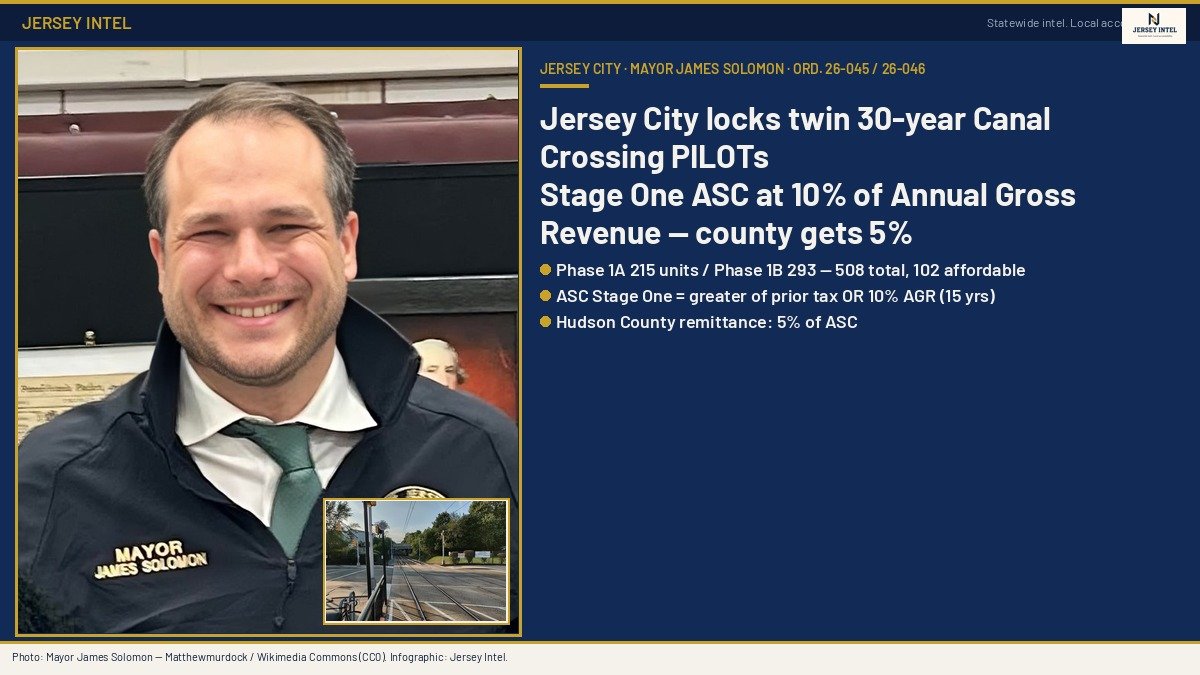
Graphic: Mayor James Solomon (Matthewmurdock / Wikimedia Commons, CC0) + Garfield Avenue HBLR West ROW inset (Sebastian Sinisterra / Wikimedia Commons, CC BY-SA 4.0) with Jersey Intel ASC chalk overlay.
- What we know: Final council passage Sept. 23, 2026; Mayor James Solomon approved Sept. 24, 2026. Ord. 26-045 (Phase 1A): six-story, 215 rental units (43 affordable ≤50% AMI), ~6,818 sq ft retail, 68 parking — estimated TPC in excess of $141 million. Ord. 26-046 (Phase 1B): ten-story, 293 units (59 affordable), ~11,462 sq ft retail, 212 parking — estimated TPC in excess of $176 million. Combined: 508 / 102 affordable. Stage One ASC = greater of Minimum ASC or 10% of Annual Gross Revenue for 15 years; city remits 5% of ASC to Hudson County.
- Why it matters: Up to 30 years off ordinary ad-valorem. Schools get no direct conventional tax line while exemption runs; county share is a slice of the PILOT. Aspire/LIHTC Incentive Grant proceeds excluded from AGR.
- What’s next: Executed FA recordings, Total Project Cost audits, and whether any city PILOT-to-schools ordinance routes these ASCs — not spelled out in the two FAs reviewed.
On Sept. 23, 2026, Jersey City’s Municipal Council gave final passage to Ord. 26-045 and companion Ord. 26-046 — long-term tax exemptions and financial agreements for Garfield Phase 1A and 1B Urban Renewal LLCs in the Canal Crossing Redevelopment Area. Mayor James Solomon approved both on Sept. 24. Stage One Annual Service Charges are the greater of the parcel’s prior-year conventional taxes or 10% of Annual Gross Revenue for 15 years; Hudson County’s cut is 5% of ASC under N.J.S.A. 40A:20-12.
JERSEY CITY — Twin 30-year long-term tax exemptions on Garfield Avenue locked in at City Hall as Trenton’s absolute vetoes of Jersey City fiscal bills dominated that late-September news cycle.
On Wednesday, Sept. 23, 2026, the Municipal Council gave second-and-final passage to Ordinance 26-045 (Garfield Phase 1A Urban Renewal LLC) and companion Ordinance 26-046 (Garfield Phase 1B Urban Renewal LLC). Mayor James Solomon approved both on Sept. 24, 2026, per the civicweb ordinance records. Each ordinance authorizes execution of a financial agreement under the Long Term Tax Exemption Law, N.J.S.A. 40A:20-1 et seq., for parcels inside the Canal Crossing Redevelopment Area.
Jersey Intel’s account tracks the ordinance roll calls and the attached financial-agreement text — not secondary donation narratives.
What Phase 1A and 1B actually build
Phase 1A (Ord. 26-045) covers Block 21501.01, Lot 1, commonly 850–870 Garfield Avenue: a new six-story mixed-use building with 215 residential rental units, including 43 affordable units at or below 50 percent of area median income; about 6,818 square feet of ground-floor retail; 68 parking spaces; plus amenity and bicycle parking as described in the FA. The city’s findings state estimated total project cost in excess of $141 million, with annual operating expenses projected at about $2 million, and expect roughly 275 temporary construction jobs and 30 permanent jobs.
Phase 1B (Ord. 26-046) covers Block 21501.02, Lot 1.01, commonly 874–902 Garfield Avenue: a new ten-story mixed-use building with 293 rental units, including 59 affordable units at or below 50% AMI; about 11,462 square feet of ground-floor retail; 212 parking spaces. Estimated total project cost in excess of $176 million; annual operating expenses about $3 million; roughly 350 temporary construction jobs and 50 permanent jobs.
Both agreements say the projects help deliver Park 12P — a plaza of about 33,000 square feet — and a portion of the Morris Canal Greenway, and that each project will operate under the city’s PECA requirements (Ordinance 18-151) and living-wage code Section 3-76.
Together the two phases are 508 rental units and 102 affordable units — arithmetic from the unit counts in the two ordinances, not a separate marketing claim.
The Annual Service Charge schedule (the money math)
Both financial agreements use the same staged ASC structure. Payment is due each February 1, May 1, August 1, and November 1 after the Annual Service Charge Start Date, for up to thirty (30) years from that start date (subject to earlier termination under the FA).
Stage One (years 1–15): ASC equals the greater of (i) the Minimum Annual Service Charge — defined as the total taxes levied against the parcel in the last full tax year it was subject to conventional taxation — or (ii) ten percent (10%) of Annual Gross Revenue.
Stage Two (years 16–18): greater of Minimum ASC; 11% of AGR; or 20% of the conventional taxes otherwise due on Improvements and Land.
Stage Three (years 19–21): greater of Minimum ASC; 11% AGR; or 40% of conventional taxes.
Stage Four (years 22–24): greater of Minimum ASC; 11% AGR; or 60% of conventional taxes.
Stage Five: year 25 — greater of Minimum ASC; 11% AGR; or 80% of conventional taxes; years 26–30 — greater of Minimum ASC; 12% AGR; or 80% of conventional taxes.
From the ASC Start Date through termination, the parcels are exempt from Land Taxes under N.J.S.A. 40A:20-12. The Entity also pays the city an administrative fee equal to two percent (2%) of that year’s ASC (N.J.S.A. 40A:20-9).
County share: 5% of ASC — not of full taxes
Section 4.08 of each FA: “The City shall remit five percent (5%) of the Annual Service Charge received by it to the County pursuant to N.J.S.A. 40A:20-12.”
That is a statutory PILOT remittance formula. It is not Hudson County’s ordinary share of ad-valorem taxes on a fully taxed $141 million–plus or $176 million–plus improvement. Schools likewise have no direct ad-valorem line on these parcels while the exemption runs. Whether Jersey City’s separate local “PILOT-to-schools” rules capture any of these ASCs is not answered in Ord. 26-045 / 26-046 or their attached FAs — an open follow for OPRA / finance ledgers, not a fact invented here.
What is carved out of “Gross Revenue”
Annual Gross Revenue tracks N.J.S.A. 40A:20-3(a) and Section 4.03 of each FA: rental income and other income from the Project, Improvements, and/or Land — without limitation or set-off in the FA’s general definition.
Expressly excluded from Gross Revenue (and from Net Profit for exemption-law compliance) are, among other items: gain on sale of the parcel/project; mortgage financing/refinancing proceeds; insurance claim payments; proceeds of Incentive Grants; and proceeds from sale of project-financing bonds.
Incentive Grant is defined as funding via the Aspire program and/or Low Income Housing Tax Credits. “The revenue from sale or financing of tax credits issued in connection with an Incentive Grant, whenever sold or financed, shall not be deemed to be revenue for purposes of calculating Annual Gross Revenue.”
So the 10% Stage One ASC is 10% of a netted rent/income base, not 10% of every dollar that finances or subsidizes the project.
City findings the ordinances adopt
Each FA’s Article II findings (incorporated via the ordinances) state that payments in lieu of taxes “will generate more revenue for the City than the current real estate taxes” on the Phase 1A / 1B parcel, and that the tax exemption is a “critical incentive” for the Entity to undertake the project in its intended scope, including the affordable units. Those findings compare PILOT dollars to current (pre-improvement) taxes on the parcel — not to the conventional taxes that would be due on a completed $141M+ / $176M+ building if it were fully on the roll.
Roll call — stick to the civicweb records
Ord. 26-045 (Phase 1A) — RECORD OF FINAL COUNCIL VOTE – Sep 23 2026: Brooks, Little, Singh, Zuppa Jr., Gilmore, Lavarro, Ephros, Griffin, Ridley (Pres.) — all AYE. Tally printed 9–0.
Ord. 26-046 (Phase 1B) — RECORD OF FINAL COUNCIL VOTE – Sep 23 2026: Brooks, Little, Singh, Zuppa Jr., Lavarro, Ephros, Griffin — AYE; Gilmore ABSTAIN; Ridley, Pres. ABSTAIN. Tally printed 7–0–2.
Introduction votes on both ordinances (Jun 10 2026) and the votes to close public hearing (Sep 23 2026) are printed 9–0 on the same civicweb records. Jersey Intel does not invent campaign-donation explanations for the Phase 1B abstentions; the primary record is the roll call itself.
Tax-crisis / veto context (cite only — do not rewrite)
Separately, on Sept. 28, 2026, Gov. Mikie Sherrill issued absolute vetoes of S-4513/A-5348 and S-4514/A-5347, listed on the governor’s legislation-actions release that day. Those veto messages — already covered on the Jersey Intel desk — address Jersey City open-space diversion and a Jersey City–limited rental-vehicle tax package. This Canal Crossing story does not re-litigate those vetoes. The timing contrast is the point: City Hall finalized 30-year PILOT instruments on Canal Crossing while the statewide fight over short-term Jersey City fiscal bills ran on a different track.
Doubt angle — who pays, who benefits, what doesn’t add up
- Who pays / who benefits: Redevelopers (Garfield Phase 1A / 1B Urban Renewal LLCs) get up to 30 years of exemption from ordinary land and improvement taxes, paying a staged ASC instead. The city argues the ASC beats current vacant/low taxes and unlocks 102 affordable units plus park/greenway pieces. Ordinary Jersey City property taxpayers and the school/county ad-valorem stack do not receive full conventional taxes on the completed improvements during the exemption term.
- County math: 5% of ASC is the statutory remittance — a small slice of an already-discounted payment stream relative to full taxes on a $141M+ / $176M+ project once occupied.
- Schools: No direct ad-valorem from these parcels under the FAs. Any local PILOT-to-schools transfer would have to be shown from other city ordinances or finance practice — not asserted from these two documents alone.
- “More than current taxes” vs full post-build taxes: The city’s relative-benefits finding is framed against current parcel taxes. It does not, on the FA text, prove the ASC equals or exceeds what conventional taxes would be on the finished buildings.
- Incentive carve-outs: Aspire / LIHTC proceeds are out of AGR. That shrinks the base for the 10% Stage One calculation relative to a gross that included tax-credit monetization.
- Split roll call: Phase 1A final 9–0; Phase 1B final 7–0–2 with Gilmore and Ridley abstaining — primary fact; secondary donation drama is out of scope.
- Still unanswered in the records reviewed: Executed (dated/signed) FA copies beyond the form attached to the ordinances; dollar Minimum ASC for each parcel (last full conventional tax year); whether any Aspire / LIHTC awards are already committed; how (if at all) ASC dollars reach Jersey City Public Schools.