
Article
After Bridgegate, will Sherrill release the Caldwell interview memos — or face a subpoena fight?
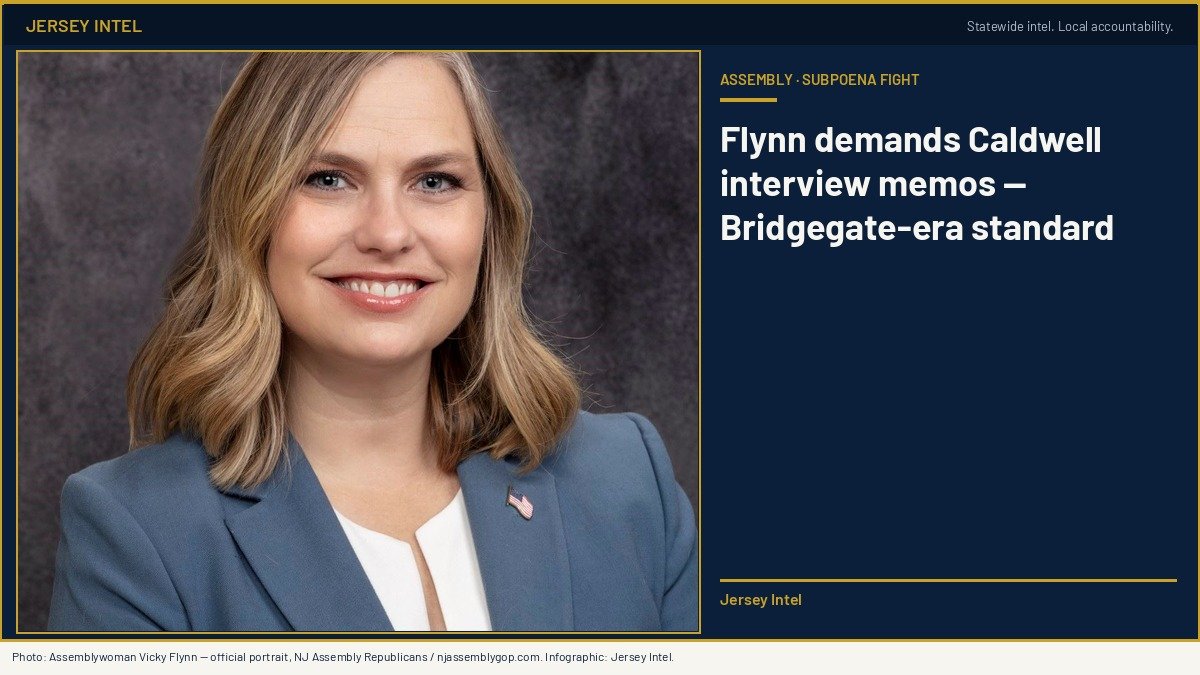
Assemblywoman Vicky Flynn is demanding release of Lowenstein interview memoranda and attorney notes from the Caldwell probe, citing the Bridgegate-era legislative demand for underlying records. A Sept. 10 Bucco–DiMaio letter already asked leaders for a bipartisan select committee with subpoena power. The primary report still does not say whether investigators interviewed the governor.
TRENTON — The public now has a 61-page investigation report on former Lt. Gov./Secretary of State Dale G. Caldwell. What it still does not cleanly answer is whether investigators interviewed Governor Mikie Sherrill, when she personally learned of workplace and ethics concerns about her running mate, and why Caldwell remained in dual LG–SOS roles while the probe ran.
Assemblywoman Vicky Flynn (R-Holmdel) is pressing that hole. In comments carried by New Jersey Globe on September 29, 2026, Flynn called on Sherrill to release underlying interview memoranda, attorney notes, and supporting documents from the Lowenstein Sandler investigation led by former Attorney General Christopher S. Porrino. If the administration will not release them voluntarily, Flynn said the legislature should form a bipartisan investigative committee with subpoena power.
Jersey Intel has not located a standalone Flynn press release or letter PDF in this sweep; Flynn quotations below are attributed to New Jersey Globe’s Sept. 29 reporting of her remarks.
What Flynn is asking — as reported
Flynn framed the demand against Caldwell’s own challenge to the findings: “Now we have an investigative report saying one thing and the former lieutenant governor saying something very different. That’s exactly why the underlying record matters.”
On precedent: “You don’t get to investigate your own administration, release a report and tell the public that’s the end of the story. They demanded the records behind the Christie report. We’re demanding the same thing now. If that standard applied to Chris Christie, it applies to Mikie Sherrill.”
On the governor-shaped hole: “The governor chose Dale Caldwell as her running mate. She put him in charge of her transition. She now says the findings against him were serious enough that he had to resign, and Caldwell says those findings are wrong. There’s a big hole in this report where the governor should be. Release the interview records and let the public see who said what, who knew what, and what the governor did about it.”
On privacy versus disclosure: “Protect the victims. Redact their names. But don’t use their privacy as a shield for the governor.”
Primary paper already on the table: Bucco–DiMaio, Sept. 10
Before the report’s public release, Senate Minority Leader Anthony M. Bucco and Assembly Minority Leader John DiMaio wrote Senate President Nicholas Scutari and Assembly Speaker Craig Coughlin on September 10, 2026, asking them to join in establishing a bicameral bipartisan select committee with equal party representation, co-chairs from majority and minority, and full subpoena authority over testimony, documents, communications, electronic records, and investigative materials.
Their numbered questions include: what Caldwell was accused of; when Sherrill and administration officials first learned; what actions were taken, by whom, and when; why outside counsel was retained and when; who decided to keep the investigation from the public; whether records were preserved; whether ethics/personnel rules were followed; and what policy changes are needed.
“The Governor cannot be the sole judge of whether her own Administration responded appropriately to serious allegations involving one of its highest-ranking officials,” the letter states.
That letter is primary. Flynn’s September 29 push sits in the same oversight lane, with an explicit Bridgegate disclosure analogy.
Bridgegate continuity — careful, not invented
Public historical record: In the Bridgegate legislative investigation, Democratic co-chairs demanded underlying interview materials from the Christie administration’s Gibson Dunn inquiry; materials were ultimately produced to the legislative committee and U.S. Attorney’s Office. Porrino served as Christie chief counsel during that period and was a principal contact for the outside investigators — a fact Flynn’s argument uses to bind past Democratic standards to present Republican demands. Jersey Intel does not invent new Bridgegate facts for this piece.
Doubt angle
Victim privacy is real; so is the documentary hole Flynn names. The Lowenstein report details March–May trainings and admonitions by senior officials but leaves Sherrill’s personal knowledge timeline and interview status opaque in the public PDF. Bridgegate precedent cuts both ways: Democrats were right to demand underlying records then; applying that standard now tests whether oversight is principle or posture. Porrino’s dual historical roles invite scrutiny of process independence — without inventing a cover-up. Caldwell’s “Ten Reasons” challenge raises the temperature but does not substitute for memos.
Legislative subpoena authority context: N.J.S.A. 52:13-1 et seq. (witnesses before the legislature). No subpoena has been issued in this matter that Jersey Intel can cite from a primary docket at deadline.