
Article
Caldwell’s ‘Ten Reasons’ vs the Lowenstein report — what he disputes, and what Sherrill still stands on
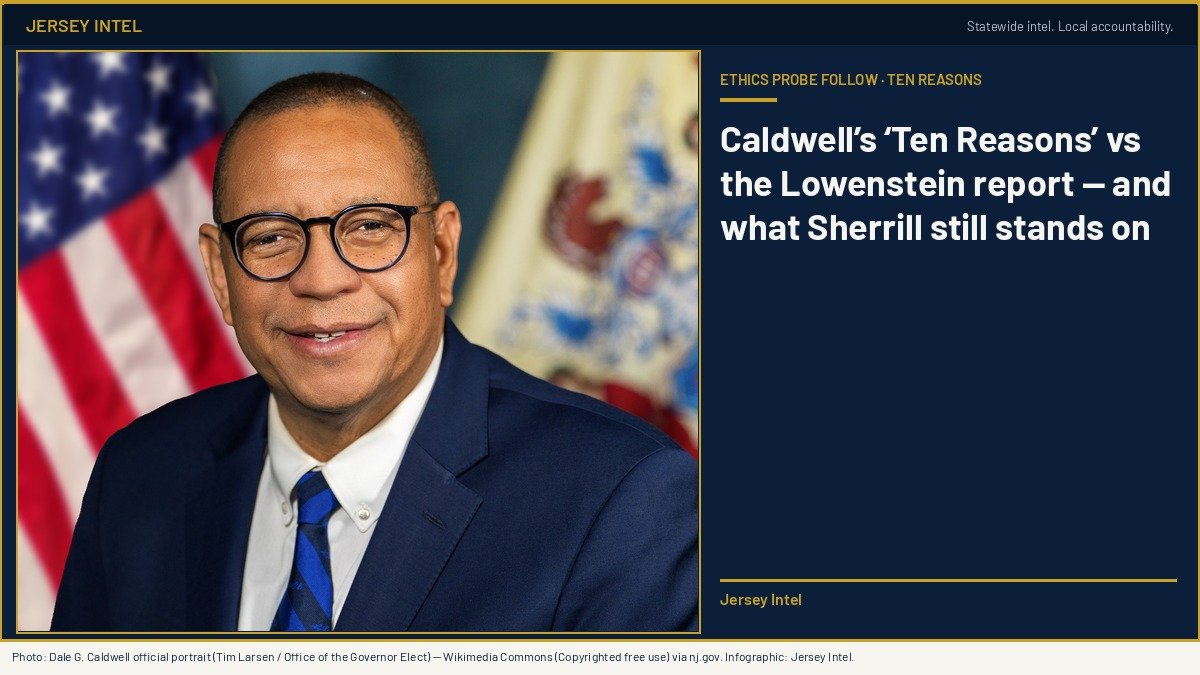
After resigning, former Lt. Gov./Secretary of State Dale G. Caldwell circulated a written “Ten Reasons the Caldwell Findings are Untrue” challenge. Jersey Intel compares those disputed points — as quoted in New Jersey Globe reporting of his written response — against the Sept. 23, 2026 Lowenstein Sandler report and the governor’s on-record stance.
TRENTON — Former Lieutenant Governor and Secretary of State Dale G. Caldwell is not treating the September 23, 2026 Lowenstein Sandler investigation as closed fact. In a written response titled, in New Jersey Globe’s account of the document, “Ten Reasons the Caldwell Findings are Untrue,” he disputes both the sexual-harassment and ethics substantiations and the process used by former Attorney General Christopher S. Porrino and Lowenstein Sandler.
Jersey Intel does not have Caldwell’s full “Ten Reasons” PDF at deadline. Quotes below of Caldwell’s written lines are attributed to New Jersey Globe’s Sept. 29 reporting of that written response. The Lowenstein report PDF and Governor Mikie Sherrill’s September 24–25 statements are primary and control Jersey Intel’s description of what investigators found and what the governor ordered.
What the primary report already found
Lowenstein Sandler (Porrino / Shontae D. Gray) concluded credible evidence substantiated:
- A Workplace Policy sexual-harassment violation, including the finding that Caldwell told a female staffer, in reference to her and her friend, that “you young women are looking for young sperm,” after a romantic advance toward the friend was rebuffed.
- Ethics violations for bringing guests to ticketed events without payment or reimbursement.
- Ethics violations for seeking a promotion for a state employee with whom he had a romantic relationship, including a May 26, 2026 state-email outreach four days after formal notice of the investigation.
Investigators wrote they “did not find his denial [of the vehicle remark] credible,” credited Staffer-1’s account (consistency, a photograph during the incident, and other evidence), and found Trooper-1’s recollection did not discredit her.
What Caldwell’s “Ten Reasons” challenge disputes (as reported from his writing)
According to New Jersey Globe’s reporting of Caldwell’s written response:
- He wrote: “There is no credible evidence of sexual harassment in the report” and “no credible evidence of intentional ethical violations.”
- On the vehicle remark: “The most salacious accusation is that I said, ‘Young women are looking for young sperm.’ Something that I would never say.” He says Trooper-1 and Staffer-5 did not corroborate Staffer-1; “Staffer-1 was believed over three other witnesses.”
- He argues findings “rely almost exclusively on Staffer-1’s testimony,” saying she appears 59 times and was interviewed multiple times while he was interviewed once, on day 48 of what he called a 133-day investigation, and was not brought back to answer final findings.
- “I was not given a chance to respond to the findings before the report was released and the Governor called for my resignation.”
- He denies the romantic-advance narrative at an official event and says the friend “was never interviewed.”
- He disputes the report’s treatment of “executive presence” as gender-coded.
- He argues the Chief Ethics Officer should have referred the anonymous complaint to the State Ethics Commission rather than retaining Lowenstein at taxpayer expense.
- He disputes the training narrative and timelines.
- On the promotion finding, he says a DCA housing director asked him to send the woman’s résumé for “exceptional field office performance,” and that he wrote “share her information as you see fit” — denying misuse of position. The primary report instead finds advocacy without disclosure of the romantic relationship, in violation of ethics codes.
- He faults staff tasked with ethics compliance and claims due-process denial based on “innuendo … hearsay,” saying he and counsel saw the report only hours before public release.
Those are Caldwell’s claims about the investigation, not Jersey Intel findings. Where they conflict with the report’s credibility determinations, the report’s text remains the primary investigative record Sherrill acted on.
What Sherrill’s office says now
Sherrill’s September 24 statement releasing the report called for resignation by the next day, citing “serious, repeated violations of state policy,” ethical lapses “despite multiple warnings and trainings,” and a “substantiated finding of sexual harassment.” On September 25 she accepted the resignation and named Acting Comptroller Shirley Emehelu Acting Secretary of State with “just 39 days” to the midterms.
After Caldwell’s written challenge circulated, spokesman Sean Higgins, in on-record comments carried by New Jersey Globe, said: “The independent investigation, conducted by a respected former Attorney General, substantiated serious violations of state ethics rules and found that his conduct constituted sexual harassment,” adding that Sherrill “committed to bringing a new culture to Trenton, and she means it,” and that “public service is a privilege – not a right.”
Doubt angle
Caldwell’s document reframes a substantiated workplace finding as a process-and-witness fight. Investigators already weighed Trooper-1 and other testimony and credited Staffer-1. Who benefits from keeping the fight on process — and off a public timeline of when Sherrill personally knew and whether she was interviewed — is the hole Flynn and minority leaders are also probing (separate Jersey Intel follow). Until Caldwell’s full “Ten Reasons” PDF and the interview memos are public, readers should treat paraphrased challenge points as attributed advocacy, not as a second investigation.