
Article
A5569 would redefine renters’ ‘rent constituting property taxes’ from 18% to 30% — and quintuple the elective credit
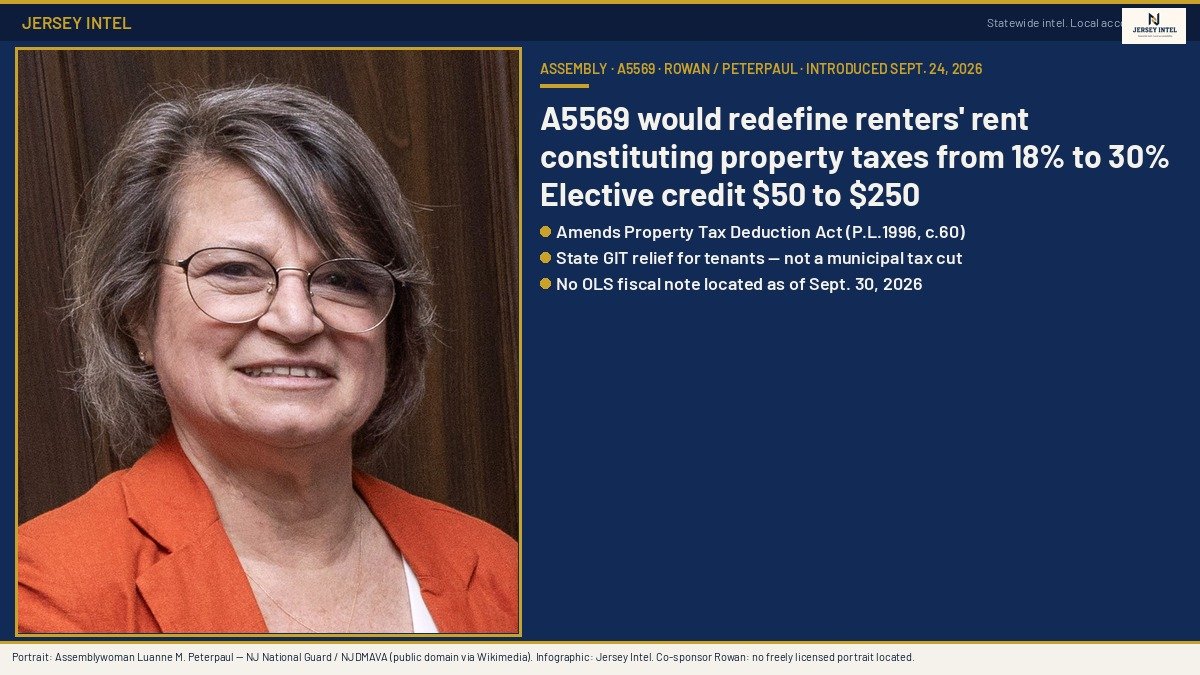
Graphic: Assemblywoman Luanne M. Peterpaul — NJ National Guard / NJDMAVA (public domain via Wikimedia Commons) with Jersey Intel A5569 chalk overlay. Co-sponsor Rowan: no freely licensed portrait located.
- What we know: A5569 introduced Sept. 24, 2026 by Rowan (D-2) and Peterpaul (D-11). “Rent constituting property taxes” would rise from 18% to 30% of rent; elective credit from $50 to $250. Applies to taxable years ending after enactment; takes effect immediately if enacted.
- Why it matters: State gross income tax relief for tenants — not a municipal property-tax cut. Feeds the Act’s up-to-$15,000 deduction path described in the bill statement.
- What’s next: Committee action and any OLS fiscal note. None located on pub.njleg as of Sept. 30, 2026 (introduced PDF only). State revenue cost unknown.
Introduced Sept. 24, 2026, by Assemblywomen Maureen Rowan (D-2) and Luanne M. Peterpaul (D-11), Assembly Bill No. 5569 would amend the Property Tax Deduction Act to raise “rent constituting property taxes” from 18% to 30% of rent paid on a principal residence and lift the elective property-tax credit from $50 to $250. As of Sept. 30, 2026, Jersey Intel located no OLS fiscal note on pub.njleg for the introduced text.
TRENTON — New Jersey’s renter tax break is written as a percentage of rent. Assembly Bill A5569 would raise that percentage — and the optional flat credit that some filers take instead.
The introduced text, dated Sept. 24, 2026, is sponsored by Assemblywomen Maureen Rowan (D-Atlantic, District 2) and Luanne M. Peterpaul (D-Monmouth, District 11). It amends the “Property Tax Deduction Act,” P.L.1996, c.60.
What the bill changes
Rent constituting property taxes. Current law, as shown in the bill’s bracketed/underlined amendments to C.54A:3A-16, sets “rent constituting property taxes” at 18% of rent paid during the taxable year for a unit of residential rental property occupied as a principal residence. A5569 strikes 18% and inserts 30%. The definition continues to include rent for occupancy of a manufactured home installed in a mobile home park.
Elective credit. Under C.54A:3A-20, certain taxpayers who paid property taxes or rent constituting property taxes may elect a credit instead of the deduction under sections 3, 4, or 5. The bill raises that credit from $50 to $250 (historical phase-in amounts for 1996–1997 taxable years in paragraph (2) are left as printed transitional language). Spouses filing separately each get one-half of the credit. The credit is paid as a refund of overpayment under N.J.S.54A:9-7 (with subsection (f) not applying).
Effective date. Section 3: the act takes effect immediately and applies to taxable years ending after the date of enactment.
What the sponsors’ statement says — and what it is not
The bill statement says the measure would provide “additional tax relief for property taxpayers” by increasing rent constituting property taxes from 18% to 30% and the elective credit from $50 to $250. It restates that under the Act a taxpayer is entitled to a deduction of up to $15,000 from gross income for property taxes, “or the rental equivalent thereof paid by tenants,” and that for tenants the deduction is based on rent constituting property taxes.
Raising the percentage, the statement says, would allow eligible gross-income taxpayers “to deduct a higher amount of rent from their gross income,” lowering income subject to taxation and “reducing a tenant’s tax burden.”
That is a state income-tax framing. The bill does not reduce the municipal property-tax levy on landlords or apartments. “Property taxes” in the Act’s definitions (as printed) means municipal ad-valorem assessments on land and improvements and shall not include payments made in lieu of taxes.
Doubt angle — who scores, what’s missing
- Who benefits most: A higher % of rent helps itemizers whose rent × 30% (subject to the Act’s caps and rules) can fill more of the gross-income deduction. High-rent counties tend to have higher absolute rent — the bill text does not target geography, but the arithmetic of a percentage-of-rent rule is not flat across the state.
- Not a local tax cut: Municipalities do not collect less property tax because Trenton redefines how rent maps into a GIT deduction or credit.
- No OLS fiscal note located: Jersey Intel checked common pub.njleg fiscal-note filename patterns for A5569 on Sept. 30, 2026, and retrieved only the introduced PDF (
5569_I1.PDF). Without an OLS or Treasury score, the state revenue cost of moving 18%→30% and $50→$250 is unknown in the public record reviewed for this report. - Credit vs deduction: Filers who elect the flat $250 credit instead of the deduction may or may not gain relative to current $50 — but the bill does not publish take-up or AGI distribution data.
- ANCHOR / other renter relief: The introduced text does not address how (if at all) the larger “rent constituting property taxes” amount interacts with ANCHOR or other property-tax relief programs. Double-counting optics are an open question, not a finding.
- Still unanswered: Committee amendments (if any); OLS fiscal note / Treasury estimate; effective taxable-year impact once enacted (none yet — introduced only).