
Article
Sherrill’s housing ‘shot clock’ and 40k homes on state land — production goals without a delivery ledger
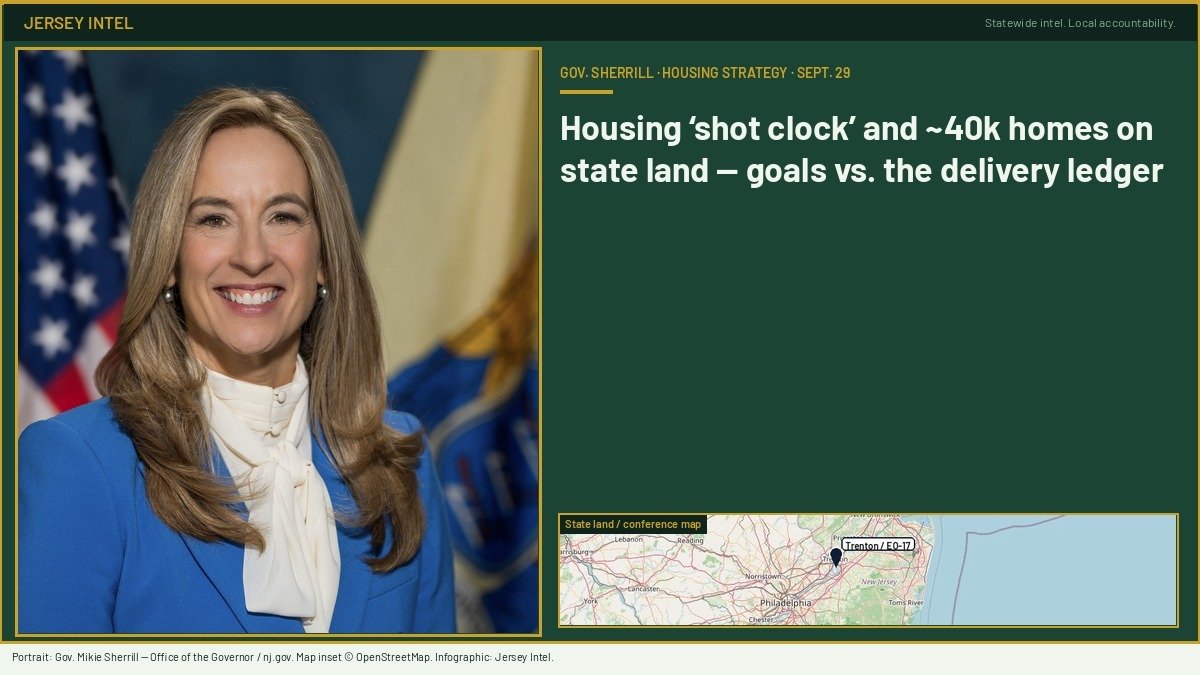
At an Atlantic City housing conference on Sept. 29, 2026, Gov. Mikie Sherrill rolled out a five-pillar Housing Strategy from the EO-17 Housing Governing Council — touting a permitting “shot clock,” a doubled state-land pipeline she frames as ~40,000 homes, and a tax-credit auction — while the underlying report still describes acreage inventory and process reforms more than finished units.
ATLANTIC CITY / TRENTON — Governor Mikie Sherrill used the 2026 Governor’s Conference on Housing and Economic Development on September 29, 2026, to brand a whole-of-government housing push: faster permits, more homes on state land, and new financing. Jersey Intel reads the primary documents for what they prove — and what they still leave as targets.
What the governor announced
The governor’s press release says the Administration’s comprehensive plan will:
- Double planned housing production on state-owned land from 20,000 to 40,000 new homes;
- Introduce a “shot clock” so permit applications move on clear timelines; and
- Deploy a tax credit auction expected to generate “tens of millions” for affordable housing.
The plan is organized around five pillars (deliver more homes; increase “speed to shovel”; partner with municipalities; expand access; lower costs / fight unfair practices). It was developed by the Housing Governing Council, established by Executive Order No. 17 during Sherrill’s first 100 days. The release cites a Council finding that New Jersey must build 350,000 additional homes to keep pace with growth and affordability.
What EO-17 actually ordered
EO-17 (primary PDF) creates definitions for affordable, workforce, and mixed-income housing and for unutilized / underutilized / surplus state property, and stands up the Housing Governing Council chaired by the Chief Operating Officer with agency co-leadership. It directs inventories of state property suitable for housing and charges the Council with formulating strategy and taking near-term action. It does not, on its face, enact numeric shot-clock deadlines or a 40,000-unit statutory mandate — those appear in the later Strategy rollout and related permitting workstreams.
What the Housing Strategy PDF says about “40,000” and the shot clock
The Housing Strategy & Progress Report (and its executive summary) is more precise than the press headline:
- NJ TRANSIT’s LAND Plan had identified underutilized parcels that could become 14,000–20,000 homes over ~30 years.
- EO-17-driven agency inventories added about 2,300 acres beyond NJ TRANSIT’s roughly 800 acres, bringing potential development on State land to 37,200–42,800 potential new homes — the range the Administration rounds into a “40,000” / “doubled from 20,000” political frame.
- Fifteen sites are highlighted for housing and economic development; the Strategy notes shovels already in the ground in places such as Woodbridge and Hoboken and transit-oriented advances in Red Bank, Bayonne, and Linden.
On permitting, the Strategy ties the “shot clock” to the Permitting Governing Council (EO 5) work with DEP, NJDOT, and DCA: cataloguing permits, a public permitting dashboard (pilot cited with complex projects / thousands of potential homes), and implementing shot-clock review deadlines on key permits. The Sept. 29 release and Strategy announce the concept and direction; they do not, in the pages Jersey Intel reviewed for this draft, publish a single statewide table of “X calendar days or deemed approved” for every permit type.
Doubt angle — accountability, not cheerleading
- Potential vs. produced: 37,200–42,800 is an acreage-derived potential over decades, not a FY2027 delivery promise. “Doubled to 40,000” compresses that range for politics; the ledger that matters is site-by-site disposition, financing, and certificates of occupancy.
- Shot clock without published day counts: Announcing a shot clock is not the same as binding, justiciable deadlines. Who benefits if the brand arrives before the regulation — the governor’s affordability narrative, or builders waiting on DEP/DOT clocks?
- 350,000 gap: Even full realization of the state-land band would cover only a fraction of the Council’s stated statewide need. State land is one pillar, not the housing market.
- Ownership retained: The Strategy says the Administration will prioritize structures that allow the State to maintain ownership of the land — a lease/ground-lease model with different risk and upside than fee-simple surplus sales. Follow the conveyance documents.