Article
Scutari’s SCI bill would end commissioner term limits and strip investigators’ peace-officer powers, ahead of Thursday’s Judiciary hearing
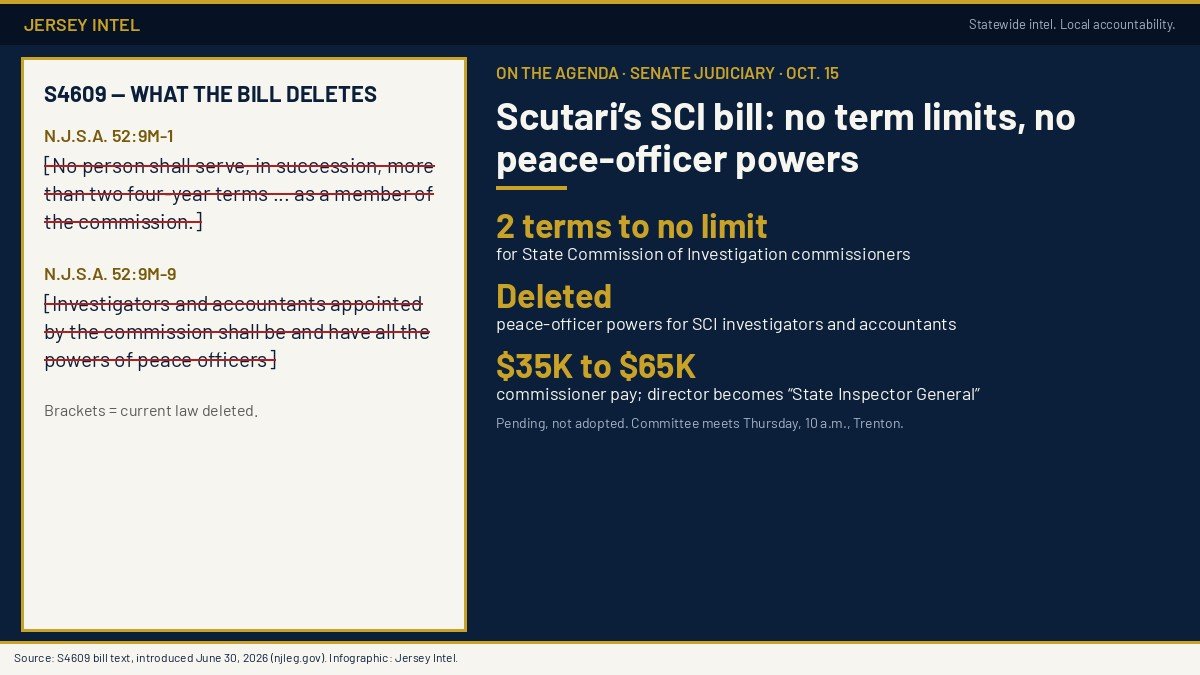
A bill from Senate President Nicholas Scutari that the Senate Judiciary Committee takes up Thursday would let members of New Jersey’s State Commission of Investigation serve unlimited terms and would delete the law that makes the commission’s investigators and accountants peace officers. Both changes appear only as bracketed deletions in the bill text.
Infographic: Jersey Intel. Source: S4609 bill text, introduced June 30, 2026.
- What we know: S4609 deletes the current two-term cap on SCI commissioners and the sentence that says SCI “investigators and accountants appointed by the commission shall be and have all the powers of peace officers.”
- Why it matters: The SCI is the state’s independent investigative watchdog, and it examines the conduct of public officials, including lawmakers. The bill changes who runs it, how long they can stay, and when it has to hand evidence to prosecutors.
- What’s next: The Senate Judiciary Committee meets Thursday, Oct. 15, at 10 a.m. Sen. Brian Stack chairs the committee. The identical Assembly bill is A5349. The bill is pending, not adopted.
No more two-term limit
Under current law (N.J.S.A. 52:9M-1), the SCI’s four commissioners serve four-year terms, and “no person shall serve, in succession, more than two four-year terms.” S4609 strikes that sentence. Commissioners would still serve four-year terms and until a successor is appointed, but with no cap on reappointment. Two commissioners are named by the governor, one by the Senate president and one by the Assembly speaker.
The bill also says that if an appointing authority doesn’t fill a vacancy within 120 days, the Chief Justice of the state Supreme Court fills it within 60 days.
Investigators would no longer be peace officers
Section 9 of the bill deletes the sentence in N.J.S.A. 52:9M-9 that gives SCI investigators and accountants “all the powers of peace officers.” The bill doesn’t replace it. It instead turns the executive director into a “State Inspector General” who serves as the commission’s lead investigator, and it makes all commission employees at-will, hired “without regard to civil service.”
The bill’s sponsor statement doesn’t explain either change.
What else the bill does
- Pay and qualifications: Commissioner salaries rise from $35,000 to $65,000 a year, and all four commissioners would have to be lawyers admitted in New Jersey. Today that applies to the two legislative appointees and at least one governor’s appointee.
- Broader reach: The SCI could investigate misconduct by “civil or criminal enforcement personnel at all levels of State and local government,” including state and county prosecutors, members of prosecution teams and detectives, as well as “fraud, waste, and abuse of taxpayer funds.” It can’t interfere with an ongoing investigation.
- One house can order a probe: Either the Senate or the Assembly could direct an SCI investigation by its own resolution. Current law requires a concurrent resolution of both houses.
- Criminal referrals: Today the SCI must “immediately” refer “any” information showing a reasonable possibility of “criminal or civil wrongdoing” to the attorney general. Under S4609, it would refer “sufficient” information of “a potential violation of the laws of this State” “at an appropriate time during the course of that investigation,” to the attorney general or another prosecutorial authority. Notifying the Office of Attorney Ethics when a prosecutor is referred would become optional (“may”).
- Immunity and subpoenas: The U.S. Attorney for New Jersey would be added to those who get seven days’ notice before the SCI grants immunity. The SCI could ask a court to quash subpoenas or discovery demands to protect its files.
- Coordination: The SCI would meet at least twice a year with the attorney general, the Election Law Enforcement Commission and the State Comptroller, and would set up a confidential complaint process for the public and government employees. The bill says the comptroller keeps its existing inspector general powers.
- Too many requests: When requests exceed its capacity, the SCI could ask the governor or Legislature for more resources, instead of asking them to review requests it can’t take on.
The law would take effect 90 days after enactment.
What doesn’t add up
The bill’s findings call the SCI “the one independent oversight entity within State government.” But it would let the officials who appoint commissioners keep reappointing them indefinitely, remove its investigators’ peace-officer status, and give the commission more discretion over when evidence of possible crimes reaches prosecutors. Lawmakers, who are among the officials the SCI can investigate, are the ones voting on it.
Earlier coverage
The Jersey Vindicator reported on the bill on July 1, covering the inspector general post, the pay raise, the all-lawyer commission, the referral timing and the Office of Attorney Ethics change. The advocacy site NJ21st noted the term-limit repeal in an Aug. 24 analysis and the peace-officer change in an Oct. 13 post urging residents to contact committee members.