Article
Gopal bill’s 15% test would bar Bank of America, Chase, Wells Fargo and PNC from at least half of N.J.’s lawsuit money
JERSEY INTEL EXCLUSIVE
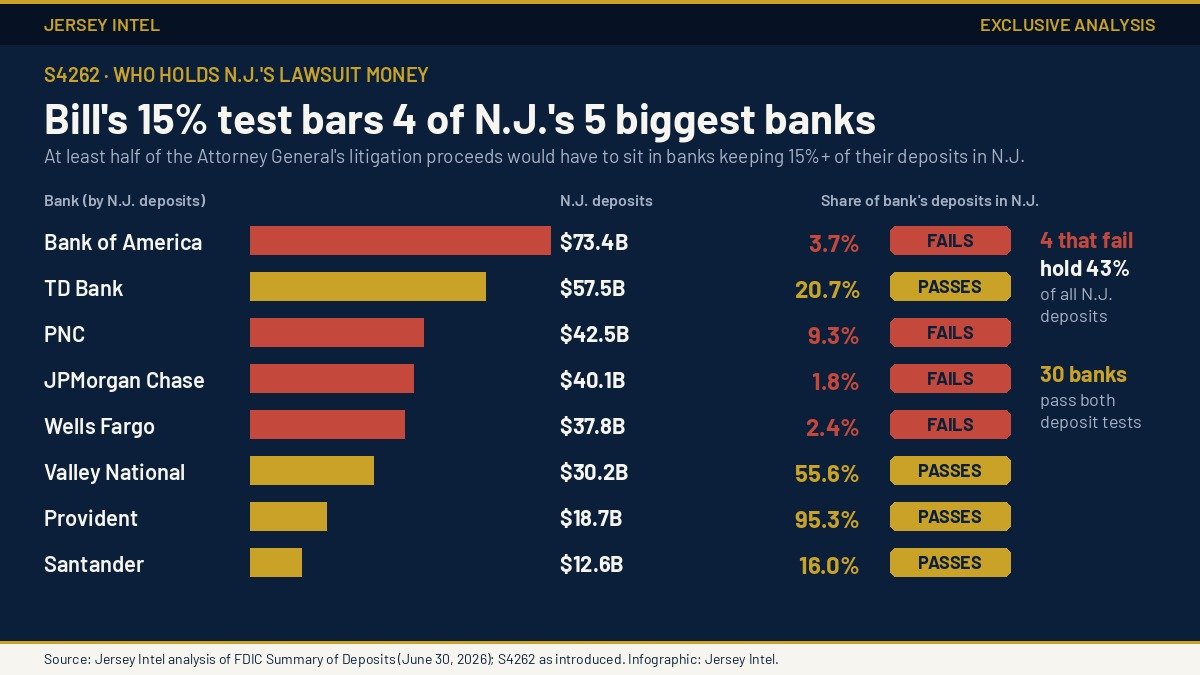
A Senate bill on Thursday’s committee agenda would require at least half of every judgment, fine and settlement New Jersey’s Attorney General wins to be deposited in banks that keep at least 15% of their deposits in the state. A Jersey Intel analysis of federal deposit data shows that test would rule out four of the five biggest banks in New Jersey.
Infographic: Jersey Intel. Source: Jersey Intel analysis of FDIC Summary of Deposits data as of June 30, 2026; S4262 as introduced.
- What we know: S4262, sponsored by Sen. Vin Gopal (D-11), would require the Attorney General to deposit at least 50% of litigation proceeds in banks that hold at least 15% of their total deposits in New Jersey and at least $1 billion overall.
- Why it matters: Bank of America, PNC, JPMorgan Chase and Wells Fargo fail the 15% test. Together they hold $193.7 billion, or 43%, of all deposits in New Jersey branches. Thirty institutions pass both deposit tests.
- What’s next: S4262 is listed for Thursday, Oct. 15, before the Senate State Government, Wagering, Tourism & Historic Preservation Committee. The Assembly version, A5163, is in the Assembly Judiciary Committee.
What the bill says
S4262 covers “money damages, civil fines, monetary restitution, settlement funds, or other proceeds” from any litigation in which the Attorney General represents the State, a political subdivision or a state agency. The Attorney General, “in consultation with the State Treasurer,” would have to deposit “at least 50 percent of such funds” in a financial institution that meets five conditions.
The bank must keep “at least 15 percent of its total deposits in the State, as set forth in the most recent Deposit Market Share Report” published by the Federal Deposit Insurance Corporation. It must also hold at least $1 billion in total deposits, offer escrow, trust or custody services, be approved and listed by the Department of Banking and Insurance, and not take litigation proceeds worth more than 10% of its total deposits.
The department would keep a directory of approved institutions. Banks the New Jersey Supreme Court has approved to hold attorney trust accounts would be “presumptively approved.” In multi-state, class-action or mass-tort cases, the rule would apply only to the share the Attorney General recovers. The bill would take effect immediately.
Gopal introduced the bill on May 14, 2026. Assemblywoman Luanne Peterpaul, who represents the same Monmouth County district, introduced the identical A5163 on June 1.
What current law allows
The bill opens with “Notwithstanding” a 1956 law, N.J.S.A. 52:18-16.1. That law tells the State Treasurer to deposit public money in “national banks located in this State,” in institutions authorized to do banking in New Jersey, or in the State’s Cash Management Fund, and to offer State deposits at public auction with interest credited to the State. Under that law, a national bank with New Jersey branches is eligible. S4262 would add a new test for at least half of the State’s litigation money.
Who passes the 15% test
Jersey Intel used the FDIC’s Summary of Deposits, the branch-level data behind the agency’s deposit market share reports, as of June 30, 2026. For each of the 104 institutions with New Jersey branches, we divided its deposits in New Jersey branches by its deposits in all branches nationwide. Those 104 institutions held $450.3 billion in New Jersey.
The largest bank in the state by deposits, Bank of America, holds $73.4 billion in New Jersey branches, but that is 3.7% of its deposits nationwide. PNC is at 9.3%, Wells Fargo at 2.4% and JPMorgan Chase at 1.8%. All four fail the 15% test. Citizens, M&T, Capital One, Citibank, Truist and HSBC also fall short.
TD Bank, the second-largest bank in the state, passes with 20.7% of its deposits in New Jersey. Santander clears the line narrowly at 16.0%, down from 17.0% a year earlier. New Jersey-based Valley National (55.6%), Provident (95.3%), OceanFirst (55.1%), Columbia (100%), ConnectOne (61.4%) and Kearny (97.8%) also pass.
In all, 30 institutions meet both the 15% and the $1 billion tests. They hold 45.4% of New Jersey deposits. Banks that fail one or both tests hold the other 54.6%. The bill’s other conditions, including trust services and Department of Banking and Insurance approval, could narrow the list further. No such list exists yet because the bill is not law.
The sponsor’s reasoning
The bill’s statement says court rules already require every attorney practicing in New Jersey to keep a trust account at a financial institution in the state, while “the State itself is not required to comply with this rule.” It says the Legislature is imposing a similar requirement “in the interests of comity with the Rules of Court.”
What the documents don’t say
The bill does not say how much litigation money the State receives in a typical year, or how much would move. The Legislature’s bill pages for S4262 and A5163 both say the bill “has not been certified by OLS for a fiscal note,” so there is no Office of Legislative Services estimate of any effect on the interest the State earns. The bill also does not explain why it sets the line at 15%, a figure that splits the state’s five largest banks four to one.
Method: Jersey Intel summed each institution’s branch deposits from the FDIC Summary of Deposits API for June 30, 2026, for New Jersey branches and for all branches. Our full table is linked below. The 2025 data gives the same pass/fail result for the eight largest banks.