
Article
Senate President’s new solar bill would let landfill and mine projects add ‘non-contiguous’ land, with no cap
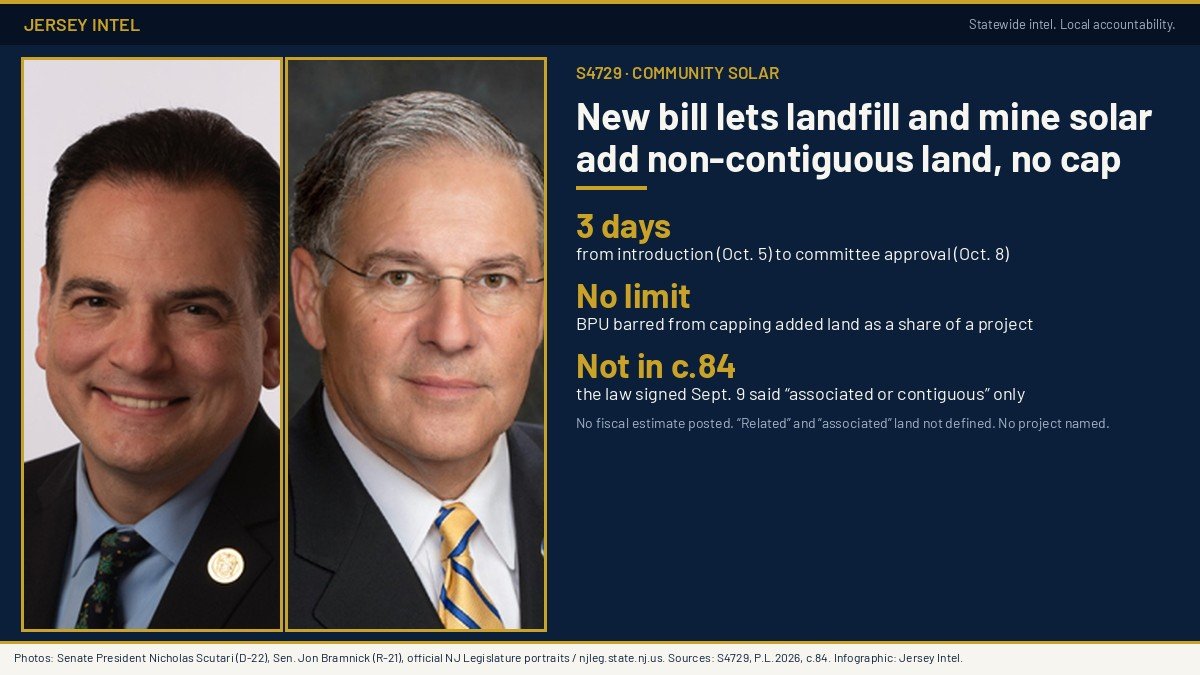
JERSEY INTEL EXCLUSIVE
Senate President Nicholas Scutari introduced a bill Monday that would let solar projects on landfills, brownfields, contaminated sites and mines in New Jersey’s community solar program take in “related, non-contiguous tracts of land,” and would bar the Board of Public Utilities from limiting how much of that land a project includes. A Senate committee approved it three days later. That language goes beyond the solar law Scutari sponsored that was approved Sept. 9, which allowed only “associated or contiguous” land, and only for public remote net metering projects.
Photos: Senate President Nicholas Scutari (D-22) and Sen. Jon Bramnick (R-21), official New Jersey Legislature portraits. Sources: S4729 as introduced; P.L.2026, c.84 (S3183, 3R); NJ Legislature bill histories. Infographic: Jersey Intel.
- What we know: S4729 was introduced Oct. 5 and reported out of the Senate Environment and Energy Committee on Oct. 8 without amendments. It was not sent to the Senate Budget and Appropriations Committee, and no fiscal estimate is posted.
- Why it matters: The bill lets landfill, brownfield, contaminated-site and mine projects count “related, non-contiguous” land as part of the same project, and says the BPU “shall not impose any limitations” based on how much of the project that land makes up. It does not define “related” or “associated” land or set any distance limit.
- What’s next: The bill is on second reading and eligible for a full Senate vote. The Senate’s next scheduled voting session is Oct. 22. An identical Assembly bill, A5636, is sponsored by Assemblyman Robert Karabinchak (D-18).
What the bill changes
New Jersey’s community solar program lets utility customers sign up for a share of a solar project located somewhere else in their utility’s territory and get a credit on their electric bill. State law has long let the BPU set “geographic limitations” for those projects and steer them to brownfields, landfills, redevelopment areas and commercial rooftops.
S4729 adds new language to that law. Under the bill, “a solar facility located on a landfill, brownfield, contaminated site, or mining site may include associated lands, contiguous tracts of land, or related, non-contiguous tracts of land, which are developed as part of the same project.” It adds: “The board shall not impose any limitations on the facility based on the proportion of associated, contiguous, or related lands relative to the total project area or capacity.”
The bill writes the same rule into the requirements for the permanent community solar program and says the BPU’s geographic limits must be consistent with it. The bill’s statement says only that it “modif[ies] the geographic restrictions” for these projects. It does not name any project, site or developer that would use the new language, and it does not say how far a “related” tract may be from the landfill or mine.
The bill keeps existing language entitling electric utilities to “full and timely cost recovery” of the costs of running the program, subject to BPU review.
A step past the law signed in September
Scutari was the first-listed sponsor of S3183, the renewable-energy overhaul that became P.L.2026, c.84 on Sept. 9. That law already lets community solar projects of 5 to 20 megawatts on rooftops, landfills, contaminated sites and mining sites register through Dec. 31, 2028, up to 300 megawatts in total, if they show they can’t connect to the PJM regional grid as wholesale projects. The BPU opened that block in a Sept. 9 order.
Chapter 84 also included a land rule, but a narrower one. It said a landfill, brownfield, contaminated-site or mining-site project “may include associated or contiguous lands developed as part of the same project,” with no limit on their proportion. That rule sits in the section of law covering remote net metering for public entities, not the community solar program. The word “non-contiguous” does not appear in it.
S4729 moves the rule into community solar and adds “related, non-contiguous tracts of land.” The law defines a mining site as a current or former sand mine, gravel pit or mine, among other extraction sites.
Fast track
The bill went from introduction to committee approval in three days. Senator Jon Bramnick (R-21) is now listed alongside Scutari as a prime sponsor on the Legislature’s bill page; the introduced text lists only Scutari. Scutari represents the 22nd District (Somerset and Union).
The committee’s action on Oct. 8 did not include a referral to the Senate Budget and Appropriations Committee. The Legislature’s site shows no fiscal estimate and no committee statement for S4729 as of Friday morning.
Questions the bill’s text leaves open: Which projects need this language? How far can a “related” tract be from the landfill or mine? Could farmland or open space count as “related” land if it is “developed as part of the same project”?
Know which project this bill is for, or have documents on a landfill or mine solar site? Send Jersey Intel a tip or email jerseyintel@gmail.com.