
Article
Hess consent judgment puts Arthur Kill claims on hold until a formal damage assessment, and only in a multi-defendant suit
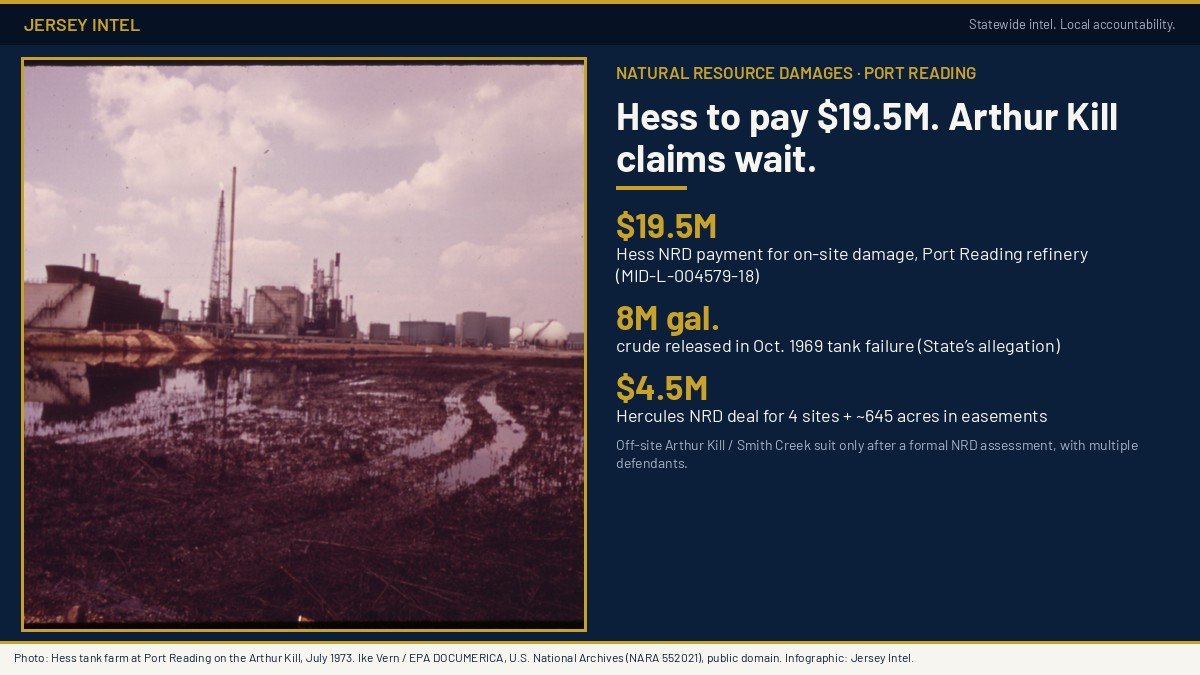
Photo: Hess tank farm at Port Reading on the Arthur Kill, July 1973. Ike Vern / EPA DOCUMERICA, U.S. National Archives (NARA 552021), public domain. Infographic: Jersey Intel.
- What we know: The Oct. 5 release from Attorney General Jennifer Davenport and DEP Commissioner Ed Potosnak announced two finalized NRD settlements “valued at more than $20 million”: Hess, $19.5 million (Port Reading refinery, Woodbridge) and Hercules, $4.5 million (four sites), plus conservation easements. The Hess consent judgment was entered Aug. 20, 2026, in NJDEP v. Hess Corp., MID-L-004579-18.
- Why it matters: The State alleges the largest discharge was an Oct. 1969 tank failure that released 8 million gallons of crude into Smith Creek and the Arthur Kill. Those off-site waters are not covered by the $19.5 million. The State has agreed not to sue over them until a formal NRD assessment is done, and only in a multi-defendant case.
- What’s next: Off-site claims and past and future cleanup-cost claims remain open. Hess keeps its argument that a 2013 consent judgment in NJDEP v. Occidental Chemical Corp. already resolved them.
TRENTON — New Jersey announced on Oct. 5, 2026 that it had finalized two natural resource damages (NRD) settlements. Attorney General Jennifer Davenport and Department of Environmental Protection Commissioner Ed Potosnak said the agreements with Hess Corp. and Hercules LLC are “valued at more than $20 million.” The money is to go toward restoring injured natural resources.
“By requiring polluters to pay for damage to our natural resources and preserve lands for conservation, these actions give us hope that future generations will enjoy the clean and healthy environment that they deserve,” Davenport said in the release.
Both consent judgments were entered in Superior Court in August and became final after a public comment period, the release says. Jersey Intel reviewed both court filings.
Hess: $19.5 million for the Port Reading refinery
According to the consent judgment, Hess began building the refinery in Woodbridge Township’s Port Reading section in 1955. It started refining and bulk storage in 1958, suspended refining in 1974, and resumed refining in 1985. In 2013 it demolished the refining portion and sold the property to Buckeye Partners, L.P. A Buckeye affiliate still runs the site as a petroleum storage facility. The release describes the site as 220 acres.
The State alleges years of spills and leaks of substances including benzene, PCBs, PFAS, TCE, MTBE, and 1,4-dioxane into groundwater, soil, wetlands, and nearby waters. “The largest discharge occurred in October 1969,” the judgment states, “when a tank failure at the Hess Property resulted in the release of 8,000,000 gallons of crude oil that impacted Smith Creek and the Arthur Kill.” Hess denied liability in its pleadings, and the settlement is not an admission.
DEP, its commissioner, and the Spill Compensation Fund administrator sued on Aug. 1, 2018 (NJDEP v. Hess Corp., MID-L-004579-18). Superior Court Judge Benjamin S. Bucca signed the consent judgment on Aug. 20, 2026. It requires Hess to pay $19,500,000 within 30 days after it is entered. The payment goes to DEP’s Office of Natural Resource Restoration.
What the $19.5 million does not cover
The press release says the State “reserves the right to file a later complaint against a larger set of defendants over off-site pollution in the Arthur Kill and Smith Creek.” The consent judgment adds conditions the release does not mention:
- The Arthur Kill comes later, with conditions. The State “will not bring any future lawsuit or administrative action for natural resource damages to the Arthur Kill” or the covered part of Smith Creek “until a formal Natural Resource Damages Assessment (NRDA) has been completed by the applicable trustees.” The trustees’ finding on Hess’s liability must also come through a process that lets Hess participate (¶23).
- Hess can’t be the only target. Any future Arthur Kill NRD suit “shall be a multi-defendant action,” and “Hess will not be the sole defendant.” DEP must “work in good faith to identify other potentially responsible parties” first (¶23). In return, Hess waives statute-of-limitations and similar timing defenses if the claims are refiled.
- Hess can argue the claims are already settled. On off-site claims, Hess “expressly reserves all defenses,” including the argument that they “were released or otherwise resolved, in whole or in part,” by a Dec. 12, 2013 consent judgment in NJDEP v. Occidental Chemical Corp. (ESX-L9868-05) (¶6).
- On-site damage before the 2013 sale is closed for everyone. Besides releasing Hess, the State agrees not to seek NRD “from any person or entity” for on-property injuries from discharges before the site was sold to Buckeye Partners around Oct. 9, 2013 (¶9).
- The current operator is out of this deal. The State dropped Buckeye Port Reading Terminal LLC from the case without prejudice on May 5, 2022. The judgment says it doesn’t change that stipulation (¶45).
- Cleanup costs are separate. Past and future cleanup and removal costs are expressly preserved (¶5, ¶6).
Hercules: $4.5 million, about 645 acres, 19 years
The Hercules case was filed on Oct. 15, 2007 (MID-L-8749-07). Under the settlement, Hercules pays $4.5 million for alleged contamination at four sites: Parlin (Middlesex), Gibbstown (Gloucester), and Kenvil and Chester (Morris). It also pays up to $50,000 in DEP costs tied to three permanent conservation easements:
- about 300 acres at the Duhernal easement property on the Old Bridge–Monroe border;
- about 110 acres at Gibbstown;
- about 235 acres at Kenvil.
The State keeps its claims for NRD to the Delaware River and for past and future cleanup costs. The settlement “does not address the defendants’ remediation obligations at the contaminated sites,” the release says.
Doubt angle: who pays for the Arthur Kill?
- The release leaves out conditions. The State’s announcement says off-site claims are “reserved” and that a later complaint could target “a larger set of defendants.” It doesn’t say the State is barred from suing until a formal assessment is finished, that Hess cannot be the sole defendant, or that Hess may argue a 13-year-old settlement already covers the claims.
- The biggest alleged spill is in the part left out. By the State’s own account, the 1969 crude release hit Smith Creek and the Arthur Kill. Those waters are carved out of the $19.5 million.
- No timeline. The Hess judgment sets no deadline for the Arthur Kill assessment. Hess’s waiver of timing defenses keeps the claim alive but doesn’t speed it up.
- Slow cases. Hess took eight years from filing to settlement, and Hercules took nearly 19.
What’s next
- Watch for proof that Hess’s payment arrived under the 30-day term, and for DEP restoration projects funded from these settlements.
- Watch for any formal NRDA or multi-defendant action on the Arthur Kill.