
Article
Appellate Panel Hears Fight Over $1.73B E-ZPass Contract — Decision Reserved
Jersey Intel — Oct. 1, 2026
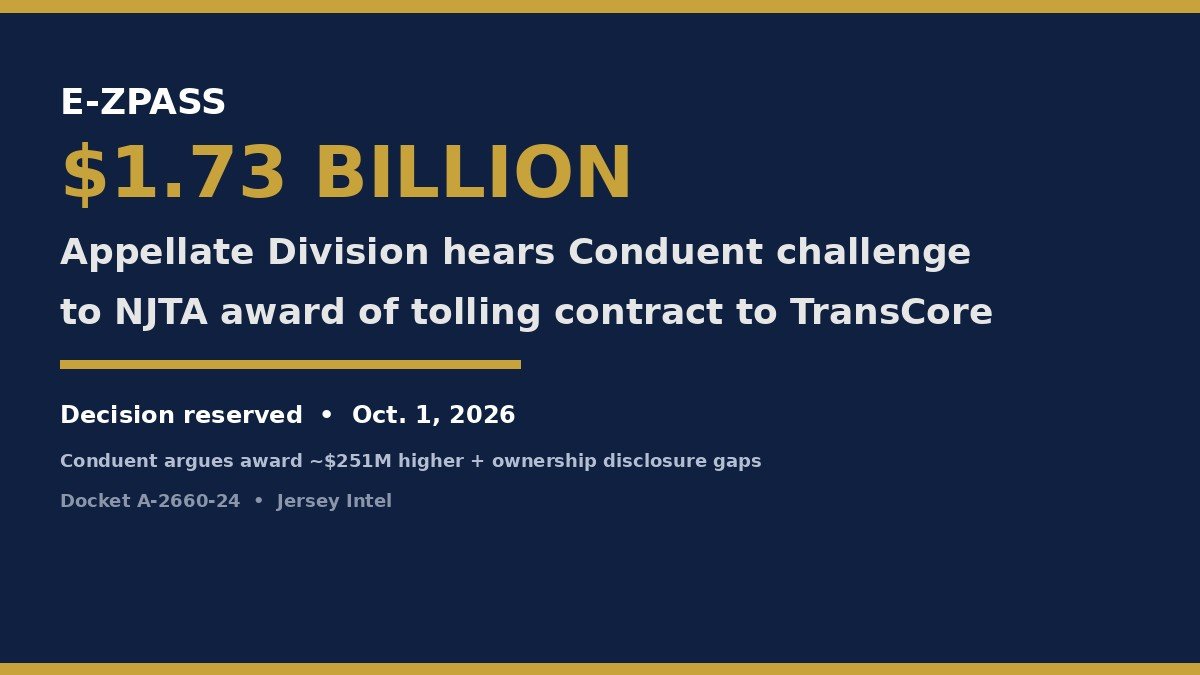
A New Jersey Appellate Division panel heard arguments Thursday in the fight over who will run the state’s E-ZPass customer-service system under a $1.73 billion New Jersey Turnpike Authority contract — and reserved decision.
The appeal, captioned In re Protest of Conduent State and Local Solutions, Inc. under Request for Proposals RM-0000178825 – New Jersey E-ZPass Services – Category A (Docket A-2660-24), challenges NJTA’s September 2024 award of Category A (Customer Service Center) work to TransCore, LP, and NJTA’s April 15, 2025 final agency decision denying Conduent’s protest.
Court filings and the Turnpike Authority’s own board materials put hard numbers on the dispute. NJTA’s Sept. 24, 2024 board agenda (Item 2024-09-231) authorized a Category A award to TransCore in a not-to-exceed amount of $1,730,747,010 for an 11-year term (implementation plus operations), with two optional one-year extensions. Conduent’s Appellate Division merits brief states TransCore’s negotiated price remained $251,257,507 higher than Conduent’s best-and-final offer — citing the Evaluation Committee report in the agency appendix.
What Conduent told the court
Conduent asks the Appellate Division to reverse the award and order a rebid. In its filed brief, Conduent argues:
- NJTA’s evaluation and protest process denied basic administrative due process — including a one-hour protest hearing without live testimony or cross-examination of evaluators.
- TransCore’s Ownership Disclosure Form failed mandatory statutory disclosure under N.J.S.A. 52:25-24.2, omitting upstream ownership that Conduent says ultimately traces to the Government of Singapore (via ST Engineering / Temasek). Conduent’s brief states NJTA’s final decision “concedes” the form “did not strictly comply,” yet NJTA still found TransCore “‘substantially’ and ‘materially’ complied” (Aa0090) and refused to disqualify TransCore.
- Staff’s recommendation and the public agenda item did not give commissioners a sound business-judgment basis to spend roughly $251 million more than the incumbent’s BAFO.
At Thursday’s argument, Conduent counsel Paul Josephson pressed those themes and — according to same-day court coverage — faulted NJTA for allowing TransCore to revise ownership-disclosure submissions during bidding. Jersey Intel has not independently located a primary document that counts “three” mid-process revisions; that specific count remains attributed to courtroom reporting pending full agency-record review.
What NJTA and TransCore say
TransCore’s opposition brief, filed Dec. 29, 2025 on the same docket, describes NJTA’s April 15, 2025 ruling as a “well-reasoned, detailed, 105-page final agency decision” that upheld the award after a years-long procurement and denied Conduent’s protest.
NJTA’s public award memo (board minutes / agenda for Sept. 24, 2024) states an evaluation committee “consistently found TransCore’s technical and operational capabilities … superior” for Category A, and that the Authority negotiated with TransCore after best-and-final offers. The same minutes describe TransCore’s plan for New Jersey-based customer-service operations staffing across two centers.
TransCore and NJTA have publicly pointed to federal national-security / CFIUS-related safeguards tied to TransCore’s foreign parent, and have rejected claims of Chinese Communist Party control. A Feb. 2025 TransCore letter to Rep. Jeff Van Drew — posted by TransCore — asserts “no connection” between TransCore or ST Engineering and the CCP and cites a National Security Agreement after CFIUS review. Those are party statements, not court findings.
Jersey Intel has the Appellate briefs that cite NJTA’s April 15, 2025 final agency decision by appendix page (Aa0001–Aa0109) — TransCore’s brief calls it a detailed 105-page ruling — but has not obtained a standalone public PDF of the full Holl decision. Exact secondary quotations attributed to hearing officer Thomas F. Holl about technical rankings and labor sourcing are not independently verified in this package and are omitted pending the FAD PDF.
The doubt angle: who pays for opacity?
Even before any appellate ruling, the public record raises questions toll payers can ask without picking a vendor:
- Why defend a higher-priced award? Best-value procurement can lawfully prefer technical scores over the lowest dollar bid — NJTA’s minutes say as much. But when the premium is a quarter-billion dollars over 11 years, the public interest test is whether commissioners actually saw comparative pricing and a written rationale, or rubber-stamped a skeletal agenda item. Conduent says the board lacked that information; NJTA/TransCore say the process was sound. The Appellate Division will decide which record controls.
- Who benefits when ownership layers stay incomplete? New Jersey’s ownership-disclosure statute exists so agencies know the “real parties in interest” before locking in long-term access to motorists’ billing and location data. If a bidder’s form stops two levels short of a foreign government shareholder — and the agency excuses it as “‘substantially’ and ‘materially’ complied” (Aa0090) — the cost isn’t only legal theory. It’s whether accountability can keep pace with a $1.7B data-rich contract.
- Procurement politics vs. drivers. Incumbents have every incentive to litigate. Challengers have every incentive to win. Neither motive substitutes for a transparent evaluation narrative. Toll payers fund both the contract and the litigation delay. A reserved decision leaves the transition calendar hanging on appellate review. Conduent’s brief states its current contract expires in October 2027; TransCore’s opposition notes an extension of the termination date until October 15, 2027, while Conduent remains the operator pending any transition.
What’s next
The three-judge panel reserved decision and will issue an opinion “in due course,” according to same-day courtroom reporting. No published Appellate Division opinion had issued as of Thursday evening.
Jersey Intel will update when the court rules — and if the full April 15, 2025 final agency decision is posted in a public repository.