
Article
Both N.J. senators voted NAY as Senate blocked Stop Insider Trading Act
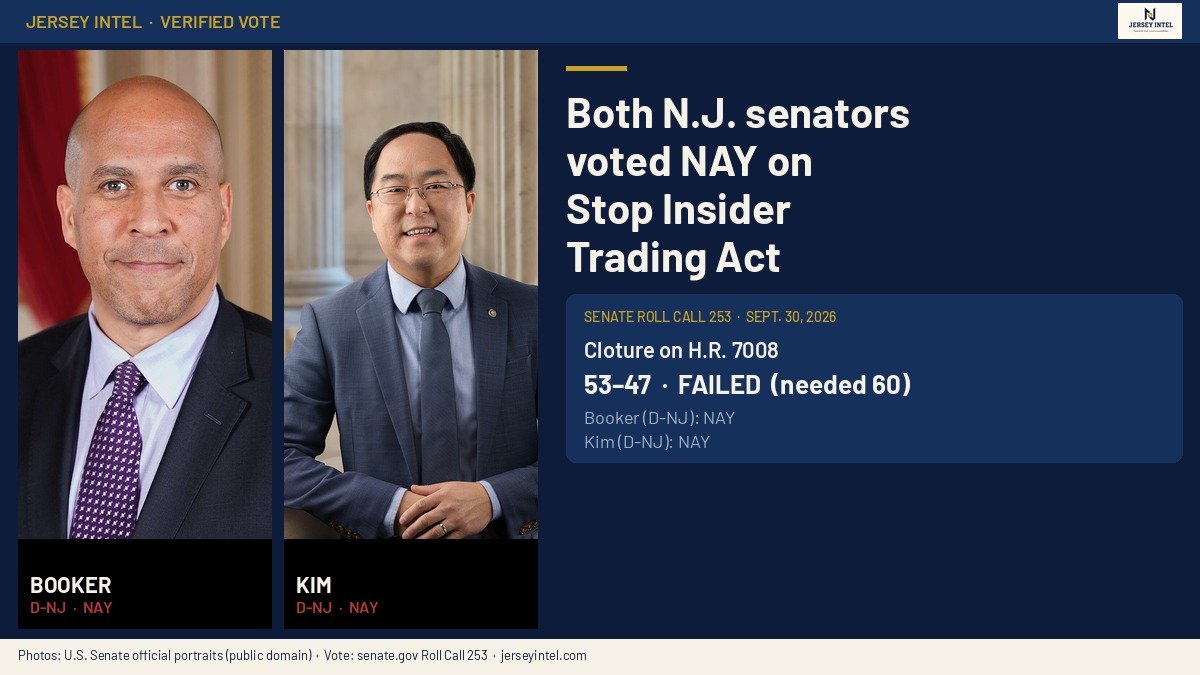
Graphic: Official U.S. Senate portraits of Sens. Cory Booker and Andy Kim with Roll Call 253 vote box. Photo credit: U.S. Senate (public domain).
- What we know: Senate Roll Call Vote 253 (Sept. 30, 2026, 11:58 a.m.) rejected cloture on the motion to proceed to H.R. 7008, the Stop Insider Trading Act, 53–47 (60 required). Booker (D-NJ), Nay. Kim (D-NJ), Nay. New Jersey grouping on the official vote page lists both as Nay.
- Why it matters: An X claim that both New Jersey senators “voted against banning insider trading” is directionally right on the Nay votes — and wrong if read as a final vote to keep illegal insider trading legal. The STOCK Act already bars classic insider trading by members; this vote was a procedural block of a narrower purchase ban plus advance-sale notice, packaged with a photo voter-ID title.
- What’s next: Watch whether a stricter ownership/divestment measure (Kim has introduced one) gets a floor vote, or whether another stock-trading bill returns after the midterms.
On Sept. 30, Sens. Cory Booker and Andy Kim joined every Senate Democrat in voting against cloture on H.R. 7008. The official roll call confirms both Nays — but the bill is not a full trading ban, and Democrats say it was diluted and paired with a voter-ID mandate.
WASHINGTON / TRENTON — New Jersey’s two U.S. senators both voted Nay on Wednesday, September 30, 2026, when the Senate refused to advance the House-passed Stop Insider Trading Act.
The official U.S. Senate roll call — Vote Number 253, 119th Congress, 2nd Session — records the question as “On Cloture on the Motion to Proceed” to H.R. 7008. Result: Cloture rejected, YEAs 53, NAYs 47, short of the three-fifths (60) threshold. Under Grouped by Home State, New Jersey shows:
- Booker (D-NJ), Nay
- Kim (D-NJ), Nay
That primary record confirms the core of a viral X post that both New Jersey senators “voted against banning insider trading” that day. Jersey Intel verifies the votes. Jersey Intel does not accept the slogan as a complete description of what was on the floor.
What H.R. 7008 actually does (engrossed House text)
The engrossed-in-House text of H.R. 7008 (GovInfo) short-titles the measure the “Stop Insider Trading Act.” On covered investments (securities of publicly traded companies and comparable synthetic interests), it would:
- Prohibit purchases by Members of Congress and their spouses and dependent children during federal service (with listed exceptions, including certain funds, small-business interests, and some trusts).
- Require advance public notice of intended sales — at least 7 and no more than 14 calendar days before the sale — filed with the House Clerk or Senate Secretary and published online.
- Assess a fee of the greater of $2,000 or 10% of transaction value, plus certain net gains, for violations — not payable from official or campaign accounts.
The same engrossed Act’s Section 3 adds a separate title: “Requiring voters to provide photo identification” under the Help America Vote Act — in-person photo ID for federal ballots, with provisional-ballot and mail-ballot copy/affidavit/notarization rules. That pairing is on the face of the primary bill text, not a rumor.
Congress.gov’s summary matches the purchase ban and 7–14 day sale-notice structure. It does not describe a ban on keeping stocks already owned, a ban on all sales, coverage of the president/vice president as a uniform rule, or a ban on private-company holdings.
How Republicans and Democrats framed the same Nay
Sen. Pete Ricketts (R-NE), in a Sept. 30, 2026 press release from his Senate office, said Democrats “disagreed when they blocked my bill to ban members of Congress from insider trading,” cited House passage 232–198 with 13 Democrats, and called the Senate outcome discouraging.
GOP floor messaging branded the measure as common-sense ethics reform.
Senate Democrats — as a bloc, every Nay on Roll Call 253 came from the Democratic caucus plus independents King and Sanders — argued the bill was not a real ban: it still lets members own and sell stocks and, in some cases, buy private-company interests. Jersey Intel treats that caucus critique as secondary color from the floor fight; the engrossed text remains the primary measure of what the bill does and does not do.
Separately, Sen. Andy Kim on Sept. 18, 2025 introduced the Restoring Trust in Public Servants Act, which his office describes as requiring divestment and prohibiting owning or trading covered investments across Congress, senior executive officials, and federal judges — a stricter architecture than H.R. 7008’s purchase-ban-plus-notice model. Kim’s prior sponsorship of a tougher bill does not erase his Nay on cloture for H.R. 7008; it does change how a one-line “voted against banning insider trading” claim should be read for New Jersey readers.
Doubt angle (required)
- Procedure, not final passage. Roll Call 253 is cloture on the motion to proceed. Failure means the Senate did not take up the bill for full debate and a passage vote. Saying senators “voted down a ban” without saying “cloture / 60-vote threshold” overstates the form of the vote.
- Name vs. content. “Stop Insider Trading Act” is the short title. Classic insider trading by members is already illegal under the STOCK Act (2012). H.R. 7008 is mainly a new-purchase restriction and pre-sale disclosure regime for publicly traded securities — still significant ethics policy, not a synonym for “legalizing insider trading.”
- What the bill leaves open. Members could keep existing holdings and sell them after notice; private securities and several fund/trust exceptions remain. Democrats called that a loophole; Republicans called Democrats’ demand for a broader ban a pretext to kill a passable bill.
- Voter ID is in the same Act. Section 3’s photo-ID mandate is primary text. Opponents say it was a poison pill; proponents say it is popular good government. Either way, a Nay is a Nay on the combined vehicle, not only on the stock title in isolation.
- Kim’s own stricter bill. Using Kim’s Nay alone to imply he opposes any stock-trading crackdown conflicts with his Restoring Trust press release and bill concept. Booker’s office had no separate primary statement located at deadline on this cloture vote; his Nay stands on the roll call alone.
Bottom line for readers
Verified: Booker and Kim both voted Nay on Sept. 30, 2026, Senate Roll Call 253, blocking cloture on H.R. 7008, the Stop Insider Trading Act (53–47, needed 60).
Not verified as phrased: That they “voted against banning insider trading” as if Congress were choosing to keep illegal tip-based trading lawful, or as if a complete ownership ban were on final passage. Primary sources support a more precise headline: both New Jersey senators voted to block advancement of this House stock-trading restriction bill — and its voter-ID title — on a party-line cloture vote.