
Article
Sherrill’s 120-day ABC clock runs out — bipartisan delay push meets Oct. 1
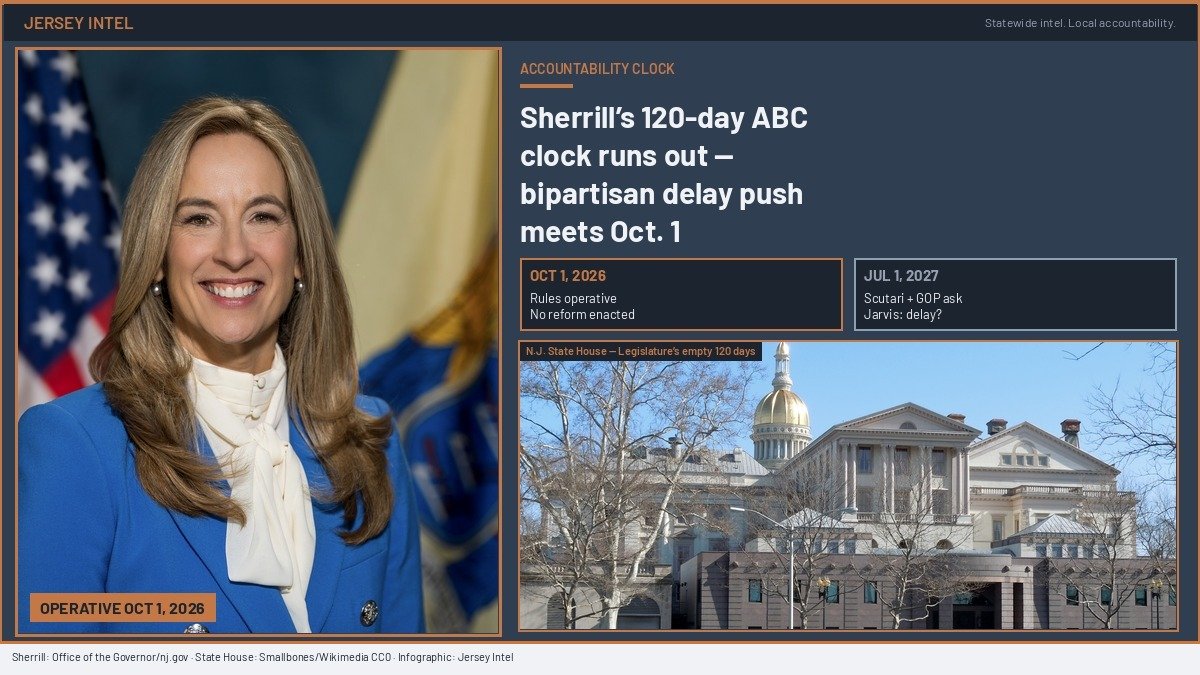
Gov. Mikie Sherrill’s administration adopted independent-contractor ABC rules on May 5, 2026, and set a 120-day operative clock to Oct. 1 for legislative reform. No statute passed. Senate President Nicholas Scutari (D) asked on Aug. 25 for July 1, 2027; Acting Labor Commissioner Kevin Jarvis has questioned whether DOL can delay on its own; Senate GOP Leaders Bucco and DiMaio on Sept. 30 demanded Sherrill stop the rule hours before it hits.
TRENTON — Governor Mikie Sherrill’s Labor Department put a clock on the Legislature. That clock is up.
On May 5, 2026, the New Jersey Department of Labor and Workforce Development adopted new rules under N.J.A.C. 12:11 clarifying the statutory ABC test used to decide whether a worker is an employee or an independent contractor for unemployment, wage-and-hour, and wage-payment purposes. The filed notice of adoption sets the operative date as October 1, 2026. NJDOL’s May 5 press release described that date as 120 days from an anticipated June 1, 2026 publication/effective date — time, the administration said, for legislative changes.
As of Sept. 30, those changes have not been enacted as a comprehensive rewrite. What has arrived instead is a last-day accountability fight over who can still stop the clock — and who benefits if it runs.
What the rule is (and isn’t), on DOL’s paper
NJDOL says the regulations synthesize decades of court decisions, including the New Jersey Supreme Court’s rulings in Carpet Remnant Warehouse (1991) and East Bay Drywall (2022), and apply across core labor statutes. Under the ABC test, the putative employer must prove all three prongs: freedom from control (A); work outside the usual course of business or outside all places of business (B); and an independently established trade or business (C).
Acting Labor Commissioner Kevin D. Jarvis, in the May 5 release, cast the adoption as clarity and a level playing field against misclassification — and said the department removed draft examples after business-community pushback during an extended comment period and public hearing.
The bipartisan delay ask — July 1, 2027
Senate President Nicholas Scutari (D-Union), in an August 25, 2026 letter to Sherrill summarized by ABC New Jersey and cited by the Senate Republican Office, asked the administration to push the operative date to July 1, 2027, arguing the initial window was too short for review of an “economy-wide regulation.”
On September 30, 2026, Bucco and DiMaio released their own letter demand: delay to July 1, 2027, convene a stakeholder working group, and stop treating tomorrow as an arbitrary deadline. Their newsflash quotes them saying the Legislature in practical terms got “a matter of weeks, not four months”; that lawmakers previously considered independent-contractor legislation and did not enact it; and that “an administrative regulation should not substitute for a legislative consensus that was never reached.” They cite more than 9,500 public comments during rulemaking, more than 99% opposed — figures also used in the NJBIA–State Chamber joint letter urging the same July 2027 delay.
The GOP leaders note lawmakers are now racing profession-by-profession carve-outs (sports officials, financial advisers, golf caddies, roadside assistance drivers, among others named in their release) rather than settling a comprehensive statute.
Jarvis: delay authority in doubt
In a mid-September interview with the New Jersey Monitor (also carried via News From The States), Jarvis said the department is fighting a “river of misinformation,” insisted the rule is “not a new test” and “not a change in enforcement,” and — on the delay question — said the adopted regs require implementation on October 1st and that he does not even know if DOL has the legal ability to delay them. That puts the political ask on Sherrill’s executive options and on the Legislature, not on a quiet administrative postponement.
Doubt angle — who benefits Oct. 1 vs. July 2027?
- Oct. 1 operative: Benefits the administration’s “clarity / level playing field” frame and any enforcement posture that treats borderline contractors as employees sooner. Workers who are reclassified as employees may gain wage, benefit, and contribution protections — and employers who already classify as employees may see competitors’ labor-cost edge shrink. DOL’s narrative is that nothing “new” is happening; if that is true, the urgency of an irreversible operative date is the unanswered question.
- July 1, 2027 delay: Benefits freelancers and businesses that rely on independent-contractor structures under today’s practice; buys the Legislature and Sherrill nine months of hearings, task forces, and carve-out politics; and softens immediate compliance shock. Scutari’s Democratic-leadership ask sitting unanswered beside a Republican same-date demand frames a bipartisan pause that the executive clock has not matched.
- What doesn’t add up yet: A 120-day “legislative window” that produced no enacted reform, a Senate President on the record for delay, a commissioner unsure he can delay, and a Sept. 30 GOP letter hours before operative day — with no published Sherrill decision in the primary records Jersey Intel reviewed for this report as of Sept. 30. Profession-specific exemption bills are a political tell that the framework’s breadth is contested even among lawmakers who never passed a replacement statute.
- Follow the ledger: Oct. 1 audit letters and misclassification assessments; any emergency rule or EO pause; and which occupations get statutory carve-outs first.
Secondary (Jarvis delay-authority quotes, quiet body attribution): New Jersey Monitor / News From The States interview, Sept. 21, 2026 — local sources/newsfromthestates-jarvis.html and sources/njmonitor-misinformation-abc.html.